Lingayen Gulf, Luzon — 9 January 1945
The ramp dropped with a metallic crash, and the world exploded into noise.
Company E, 103rd Infantry Regiment, 43rd Infantry Division, surged forward into waist‑deep surf, rifles held high, the air thick with the smell of salt, diesel, and cordite. Japanese artillery thudded in the distance, shells bursting inland as the first waves clawed their way onto the beaches of Lingayen Gulf. The sun was barely up, but the heat was already rising, shimmering off the water like a warning.
Men stumbled through the surf, boots dragging in the sand, packs heavy with ammunition and rations. The beach was a chaos of shouting, smoke, and the grinding roar of landing craft backing away for another load. Engineers were already clearing mines. Medics knelt beside the wounded. The 43rd Infantry Division had come ashore.
Company E pushed inland, fanning out across the flat coastal plain. The first day was a blur of movement—securing the beachhead, digging in, watching the sky for enemy aircraft. Snipers harassed the perimeter. Machine‑gun bursts cracked from tree lines. Every shadow looked like a rifle barrel.
But the landing had succeeded. Now came the hard part.
10 January 1945 — Moving Inland
At dawn, Company E advanced beyond the beachhead, moving through rice paddies and low brush toward the interior. The ground was soft and uneven, cut by irrigation ditches that slowed the men to a crawl. The Japanese had fallen back from the beaches, but they had not gone far.
The first shots came from a cluster of nipa huts along a narrow road. A machine gun opened up, stitching the ground with dirt‑spitting bursts. The men dropped instantly, returning fire as squads maneuvered along the dikes. Smoke grenades hissed. A bazooka team crawled forward, mud caked to their elbows.
The gun fell silent after a sharp explosion. But the advance didn’t get easier.
Snipers fired from palm trees. Mortar rounds thumped into the fields, sending geysers of mud into the air. The company moved yard by yard, clearing huts, probing hedgerows, flushing out hidden positions. Every few minutes, someone shouted “Medic!” and the column halted while the wounded were carried back toward the beach.
By nightfall, Company E had pushed nearly a mile inland. They dug foxholes in the dark, listening to the distant rumble of artillery and the closer rustle of movement in the brush. Japanese soldiers probed the lines, testing for weak spots. Flares arced overhead, turning the paddies ghost‑white. Sleep came in fragments.
11 January 1945 — Toward the Agno River
The next morning, the company moved toward the Agno River, a key Japanese defensive line. The terrain tightened—fields gave way to thickets, dikes, and scattered villages. The enemy was no longer retreating. They were dug in.
Company E approached a narrow road bordered by cane fields. The silence felt wrong.
Then the world erupted.
Machine‑gun fire tore through the cane stalks. Mortars crashed down, shaking the earth. A Japanese bunker, hidden beneath woven mats and brush, spat fire across the road. Men dove for cover, shouting orders, returning fire where they could.
Squads maneuvered along the flanks, crawling through mud and tangled roots. Grenades arced into the bunker. The explosion shook the ground, followed by a brief, eerie quiet.
But the fight wasn’t over. More fire came from a second position. Then a third.
The company pressed on, clearing each strongpoint in turn. It was slow, brutal work—close‑quarters fighting in heat and smoke, every movement watched by an enemy determined to hold the line.
By late afternoon, the Japanese resistance broke. Company E secured the area, exhausted, sweat‑soaked, and mud‑covered. They had advanced only a few hundred yards, but it had cost them dearly.
The Bronze Star
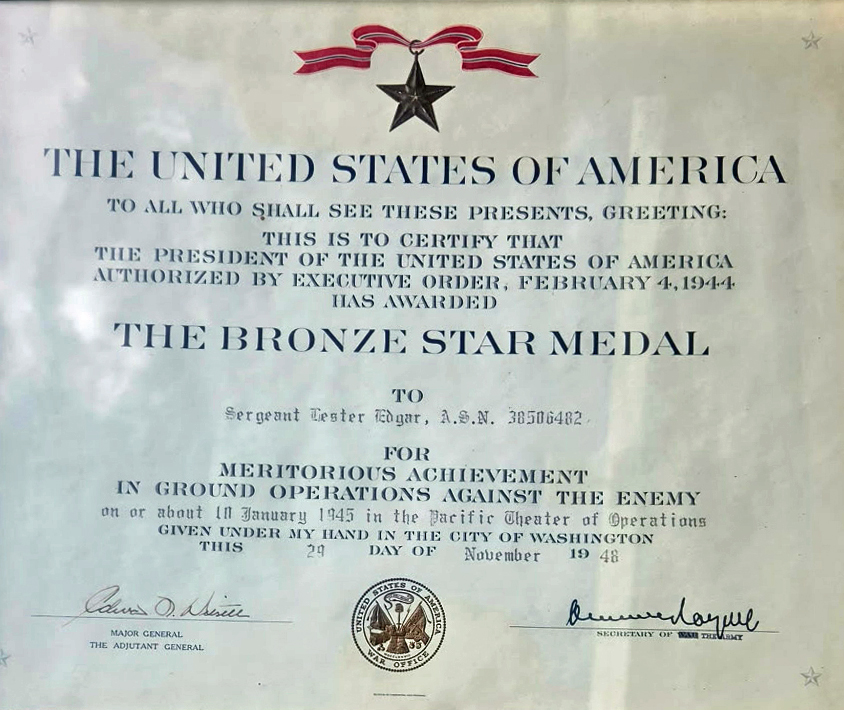
Somewhere in that chaos—amid the gunfire, the shouted commands, the push to keep the line moving—Private First Class Lester Edgar1 performed the actions that would later earn him the Bronze Star Medal for “meritorious achievement in ground operations against the enemy on or about 10 January 1945.”
The citation did not record the details. It didn’t need to. Anyone who fought on Luzon in those days understood what it meant.
Aftermath
As night fell on 11 January, Company E dug in again, this time on ground they had fought for inch by inch. The air smelled of smoke and churned earth. The men cleaned their rifles, checked their ammunition, and waited for the next day’s orders.
The campaign had only begun.
But the beachhead was secure. The inland roads were opening. And the long, grinding battle for Luzon—one of the largest and most decisive of the Pacific War—was underway.
Footnote
1Private First Class Lester Edgar was promoted to Sergeant only two months later.
Page last updated May 6, 2026
Search the Staggs Family History site