BIRTH: 6 Oct 1788, Pembroke, Massachusetts, USA
DEATH: 21 May 1866, Valparaiso, Indiana, USA
FATHER: Zebulon Keene (1765-1810)
MOTHER: Hulda Sprague (b. 1765-70 d. 1820-28)1
SPOUSE: Chloe Higgins (1790-1864)
When Sprague Keene was born on October 6, 1788, in Pembroke, Massachusetts, his father, Zebulon, was 23 and his mother, Huldah, was 22. He married Chloe Higgins on January 24, 1808, in Cortland, New York. They had nine children in 27 years. He died on May 21, 1866, in Valparaiso, Indiana, having lived a long life of 77 years, and was buried there.
The life of Sprague Keene
A Frontier Childhood, a Life of Labor and Faith, and the Patriarch of a Midwestern Family
Sprague Keene was born on 6 October 1788 in Massachusetts, the son of Zebulon Keene and Hulda (Sprague) Keene. When he was “a little over seven years old,” as he later wrote, his parents left New England and moved into the deep forests of what would become Homer, Cortland County, New York. In 1795, the region was still a raw frontier. Only a dozen families lived within ten miles, and wolves, bears, and panthers were more common than neighbors. Sprague grew up in this wilderness, learning early the skills of clearing land, felling timber, and coaxing a farm out of the forest floor.
On 24 January 1808, at McGrawville, New York, Sprague married Chloe Higgins (1791–1863), daughter of Timothy and Ruth Higgins. Both were young, poor, and determined. “I commenced life for myself,” Sprague later wrote, “with nothing in the world but an acre and a woman — and she was as empty‑handed as myself.” Together they built a home in the woods, raising children while carving a livelihood from the land. Sprague worked as a stone mason and cooper, trades that connected him to nearly every household in Homer and Cortlandville. Chloe managed the home, the children, and the endless work of frontier domestic life.
Their early years were marked by hardship. They struggled to acquire cattle, lost land due to faulty deeds, and endured the constant labor of clearing fields and building structures. Yet Sprague believed that God had preserved him for a purpose. He described a moment when a falling tree nearly killed him — an experience he interpreted as divine intervention. From that day, he committed himself fully to the Christian faith. He and Chloe joined the local church, though attending services was difficult. Horses were scarce, and for years they had none. Chloe would ride to meeting on horseback with a baby in her arms while Sprague trotted beside her — a scene he remembered as both common and admirable in those days.
By 1820, Sprague and Chloe had four young children — Zebulon, Lorenzo, Amos, and Lydia — all under ten. The 1820 census captures them as a young family in the woods, with Sprague engaged in agriculture and Chloe managing a bustling household. By 1830, the family had grown, with older sons entering adulthood and younger children still at home. Sprague’s trades as mason and cooper kept him connected to the growing community, and his reputation for honesty and hard work became well known.
Their granddaughter, Mary Jane (Keen) Polhamus, later wrote that Sprague and Chloe were “well‑to‑do farmers” and “well‑liked by all their neighbors and friends.” She remembered visiting their farm as a child — wandering the fields with her Aunt Mary, exploring the barns, and delighting in her grandmother’s pantry filled with gingerbread, cheeses, maple sugar, and golden rolls of butter. Chloe would secretly wrap a large roll of butter for Mary Jane to take home, whispering, “Don’t let Grandpa see it,” though everyone knew Sprague was just as generous. “That is just Grandmother’s way,” the children would say.

By 1850 and 1855, Sprague and Chloe were still living in Cortlandville, now in their sixties, with only their youngest daughter Mary still at home. Their older children had married, moved out, or begun migrating west. In the mid‑1850s, Sprague and Chloe followed their youngest son Timothy to Porter County, Indiana, joining the growing Keene presence in the Midwest. The 1860 census shows them living with Timothy and his family, Sprague still listed as a farmer at age seventy‑two.
Chloe died in 1863, and Sprague followed her on 21 May 1866. They are buried together in Porter County beneath a single stone carved with a hand pointing upward — a nineteenth‑century symbol of Christian hope. The inscription reads simply: “At rest — Sprague Keen, 1789–1866; Chloe, his wife, 1791–1863.”
The following is an excerpt from Staggs Genealogy – Harold Wareham Staggs – His Book
Zebulon was a cooper and a stone cutter and owned a cooperage in McGrawvill, New York. In 1793 the family moved to Homer, Cortland Co., New York, and located in this, then sparsely inhabited, area to farm.
Their first son was Grandfather Sprague (1788) who moved to Valparaiso, Indiana. He married Chloe Higgins (1808) and they had nine children.
In Sprague Keen’s ‘Notebook” written in 1864 he tells us, while writing about his early life at Homer, New York, “from where my father settled amidst of all kinds of wild beasts and not but 12 or 15 families in town ten miles square here, I grew to 19 and I had a good chance to get acquainted with the inhabitants here I commenced in life for myself had nothing in the world but an acre and a wooman and she was as empty handed as myself and word in my dealings with others for I had seen enough to make me think that honesty was the best policy”. Later in his book he tells us “after Lydia was born and her Mother got smart enough I hired a horse one Sunday to go to prestirian Communion and present her baby for Sprinkling when we got ready to start she gave Lydia a dose of petragoric or Lodlon we started she on horseback and I trotting along by her side that was a fair thing too she sat in one part of the house and I in another” “House” meant church.
We will say that when Sprague started a sentence, there was no stopping him! Now I’ve got a question for you. At another part in his book he tells us, “I had burrow a horse to ride in comming home down the hill west of homer he stumbled down on his knees throwing me off over his head flat on my back and Swabling over me trying to get up I got up as soon as I could for I thought was no fun there for me: Just what was that fool horse doing???
Mary Jane Keen, a granddaughter of Sprague, wrote that her mother, Hanna Jane Webster was left an orphan when little and raised by a couple named Graves. She also states that in later life Zebulon was a carpenter.
When I was about ten, our family went to Valparaiso and from there, with the Warehams, went to a Keen family reunion. It was held on the farm that Sprague bought when he moved to Indiana. I remember the large number of kin there and the long tables of food that the ladies had cooked.
Grandfather Sprague, like his father, was a stone mason and cooper.
The following is an excerpt from The John Keen(e) (1578-1649) and Associated Families, by Mr. and Mrs. Archie Timothy Keene, 1971
Sprague Keen, son of Zebulon and Hulda, born 10-6-1788, died 5-21-1866 in Valparaiso, Ind. He was born in Mass., went to Cortland Co., N.Y. in 1795, married Chloe Higgins 1-24-1808 at McGrawville, N.Y. She was the daughter of Timothy and Ruth Higgins, born 9-25-1791, died 5-11-1864 in Valparaiso. Sprague was a stone mason and cooper in Homer and McGrawville, N.Y. They had nine children.
Sprague Keen Note Book
Sprague Keen, son of Zebulon and Hulda Keen, wrote a resume of his early life as experienced by him and his wife Chloe in their homesteading days near Homer, Cortland County, N.Y. It was addressed to Timothy and Susan Keen and written 6-24-1864 (or started then) just two years before his death in 1866. He elaborated upon his conversion to the Christian faith, claiming that while chopping down trees in his woods, one came perilously near striking him on the head, that it surely would have done so but for an act of God. They had many difficulties in acquiring cattle and land and actually lost on property after it was paid for, because of a fault in the negotiations or in the deed.
He wrote:
About every man in the town homer (sic) and Cortland had lived four years in homer (sic) village worked at coopering which give me a chance to get acquainted with great many out in the country their was the county seat of business and that was where the regiment met for training and the two towns met before they were divided and celebrations of the fourth and other gatherings and within one mile and a half from their (sic) my father settled down in the woods when I was a little over seven years old amidst of all kinds of wild beasts and not but 12 or 13 families in the town ten miles square here I grew to 19 and I think I had a good chance to get acquainted with the inhabitants here I comeced (sic) in life for myself had nothing in the world but an acre and a wooman (sic) and she was as empty handed as myself and in starting I thought I would try to be honest and up to my word in my dealings with others for I had seen enough to make me think that honesty was the best policy.
I had no horse for two years I think after I united with the Church for that reason your Mother could not goe (sic) very steady horses were very scarse (sic) in the neighborhood would get a chance to goe on horse back and Carry a baby in her arms and though that was a great privilege to get to meeting when we could both goe at a time would goe to one house but it was seldom that we could the oldest child was not old enough to take care of the youngest after Lydia was born and her Mother got Smart enough I hired a horse one Sunday to go to home to presterian Communion and present her baby for Sprinkling when we got ready to start she gave Lydia a dose of petragoric or Lodlom we started she on horse back and I trotting along by her side that was a common thing in those days to see and thought it was a fair thing too …”
Memories of Mary Jane Keene Polhamus, written June 1922
Many years ago near the town, of McGrawville, in Cortland. Co., N. Y, there Lived a family by the name of Sprague Keene and his wife Cloe. They were well-to-do farmers. He was a man with many excellent qualities, well-liked by all his neighbors and friends. I think, if. I am rightly informed, they were Baptists.
the Keene Family consisted of four sons and two daughters. The eldest son, Zebulon was a carpenter. He raised a large family. His wife, my mother, was Hanna Jane Webster. Left an orphan when young, she was adopted by a couple named Graves.
Lorenzo, the second son, was a noted Doctor, LaPorte, Ind. was his home for many years. Here he was well known avid well loved. During the Civil War, he served as a war surgeon. After the war he returned to LaPorte and resumed his practice.
The third son., Amos, of which I knew but little, but think at the time of his sudden death, he and my father were in a grocery business in Mt. Morris, N. Y. State.
Timothy, the youngest son, lived with his father and mother and later came West with them.
Lidia, the eldest daughter, married a man by the name of Andrews. They came West and settled in Reedsburg, Sauk Co., Wisconsin. As far as I know she had one daughter whose name later became Palmer. She died leaving two daughters but all trace of them has been lost as far I know.
Mary, the youngest daughter, who married Thomas Ransom, lived in your midst many years, and was well known and loved by all. Some of her descendants are here to-day.
In the intervening years, Sprague Keene, his wife and youngest son Timothy and family, came West and located near Valparaiso. Timothy lived with his parents until their death and continued on the home farm until he also died at an old age.
Sprague Keene and his sons all lived to the ripe old age of 80 years and over.
I do not know the nationality of Sprague Keene and his wife, but when they came west, they were known as Down East Yankees.
Some of the sweetest memories of my childhood days were the visits to my Grandfather’s farm. When I used to wander with my Aunt Mary, hand in hand over the farm place, spying out the many wonderful things you see on a farm. This was to me as a child, quite a novelty. I also liked to visit my Grandmother’s pantry, which was always well stored with goodies. How well I remember the cookie jar, her delicious gingerbread and her wonderful cheeses. Also, the sugar room where there was always a great supply of maple sugar, pure and lucius, to which we always had free access. She also made such great rolls of wonderful golden butter. Many times, when I was about to depart for my home, she would wrap up a large roll of butter and say, “Here, Mary Jane, take this to your mother, but don’t let Grandpa see it.” We used to wonder why Grandmother said this because we knew Grandfather was just as willing as Grandma that Hannah should have the butter, but we would end up by saying, “That is just Grandmother’s way.”
By: M. J. Polhamus
Legacy of Sprague Keene
The legacy of Sprague Keene is found in the generations who followed him across New York, Indiana, Michigan, Wisconsin, and beyond. His eldest son Zebulon carried the family west and became the patriarch of the large Keen family recorded in the Webster Genealogy. Dr. Lorenzo Keene became a respected physician and Civil War surgeon in LaPorte, Indiana. Amos, Lydia, Mary, and Timothy each contributed to the spread of the Keene family across the Midwest. Through his daughter‑in‑law Hannah Jane (Webster) Keen, Sprague’s descendants inherited the deep colonial roots of the Webster and Graves families. Through his grandchildren — including Elnora Adelaide Keen, Emma Wilmina Keen, Mary Jane Keen Polhamus, and many others — his line merged with the Crowe, Polhamus, Hickok, Perry, and Wareham families.
Sprague’s life was shaped by the American frontier: by wilderness, labor, faith, and family. He began with nothing but “an acre and a woman,” and from that humble beginning he built a legacy that stretched across states and generations. His story is the story of early America itself — the movement from New England to New York to the Midwest, the transformation of forests into farms, and the quiet strength of the families who built communities from the ground up.
Parents
FATHER: Zebulon Keene (1765-1810)
MOTHER: Hulda Sprague (b. 1765-70 d. 1820-28)1Married
Chloe Higgins (1790-1864). Married January 24, 1808, in McGrawville, New York, USA.
Children
- Zebulon Keen (1808-1808)
- Zebulon Keen (1811-1897) married Hannah Jane Webster (1816-1889)
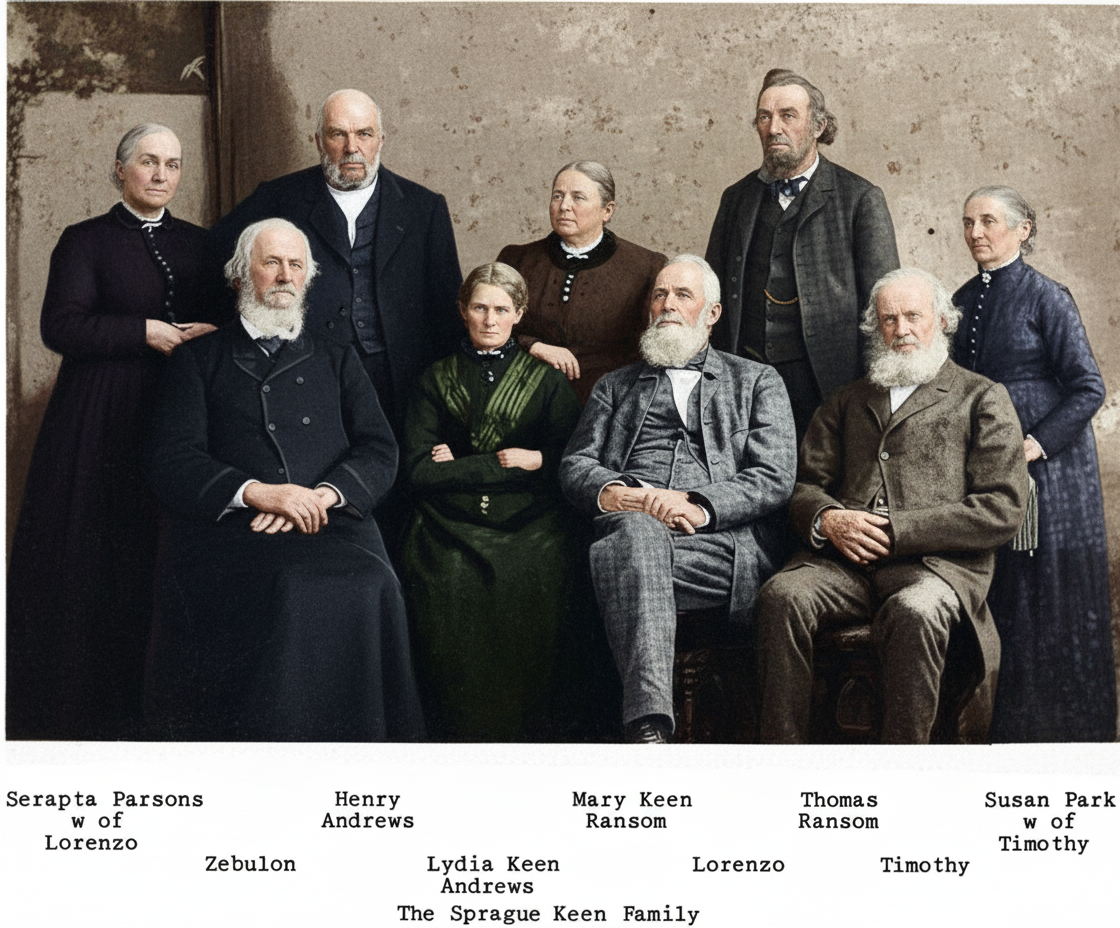
- Lorenzo S. Keen (1813-1907) married Sarepta Parsons (1827-1907)
- Amos Keene (1815-1846)
- Lydia B Keen (1816-1895) married Henry W Andrews (1817-1897)
- Mary Keen (1819-Bef. 1830)
- Timothy D Keene (1821-1907) married Susan Park (1827-1892)
- Normon Keen (1826-1829)
- Adino F Keene (1831-1840)
- Mary Bailey Keen (1835-1902) married Thomas J Ransom (1831-1915)
Documents
- Birth Records
- The John Keen(e) (1578-1649) and Associated Families > Sprague Keen, son of Zebulon and Hulda, born 10-6-1788, died 5-21-1866 in Valparaiso, Ind.
- Find A Grave Birth date 16 Jun 1788
- Marriage records
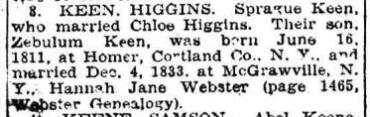
- Gen. Column of the ” Boston Transcript”. 1906-1941, 31 Dec 1935 > KEEN. HIGGINS. Sprague Keen, who married Chloe Higgins. Their son, Zebulum Keen, was born June 16, 1811, at Homer, Cortland Co., N. Y., and married Dec. 4, 1833. at McGrawville, N. Y., Hannah Jane Webster (page 1465, Webster Genealogy).
- The John Keen(e) (1578-1649) and Associated Families > Sprague Keen, son of Zebulon and Hulda, born 10-6-1788, died 5-21-1866 in Valparaiso, Ind. He was born in Mass., went to Cortland Co., N.Y. in 1795, married Chloe Higgins 1-24-1808 at McGrawville, N.Y. She was the daughter of Timothy and Ruth Higgins, born 9-25-1791, died 5-11-1864 in Valparaiso. Sprague was a stone mason and cooper in Homer and McGrawville, N.Y. They had nine children.
- Death records
- The John Keen(e) (1578-1649) and Associated Families > Sprague Keen, son of Zebulon and Hulda, born 10-6-1788, died 5-21-1866 in Valparaiso, Ind.
- Find A Grave Death Date 21 May 1866
- Census Records
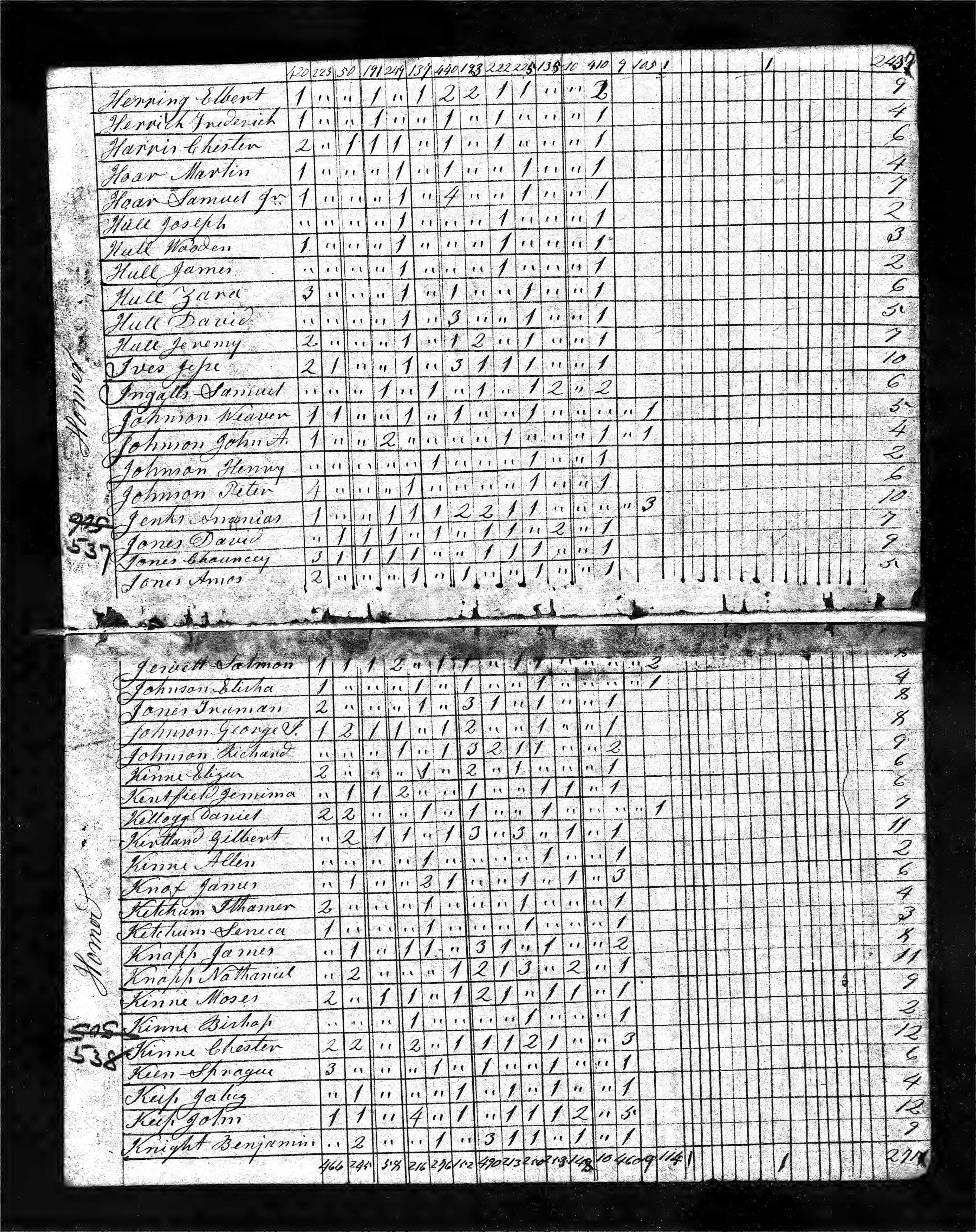
- 1820 United States Federal Census > New York > Cortland > Homer > Name: Sprague Keen; Enumeration Date: 7 Aug 1820; Home in 1820 (City, County, State): Homer, Cortland, New York, USA; Free White Persons – Males – Under 10: 3; Free White Persons – Males – 26 thru 44: 1; Free White Persons – Females – Under 10: 1; Free White Persons – Females – 26 thru 44: 1; Number of Persons – Engaged in Agriculture: 1; Free White Persons – Under 16: 4; Free White Persons – Over 25: 2; Total Free White Persons: 6; Total All Persons – White, Slaves, Colored, Other: 6
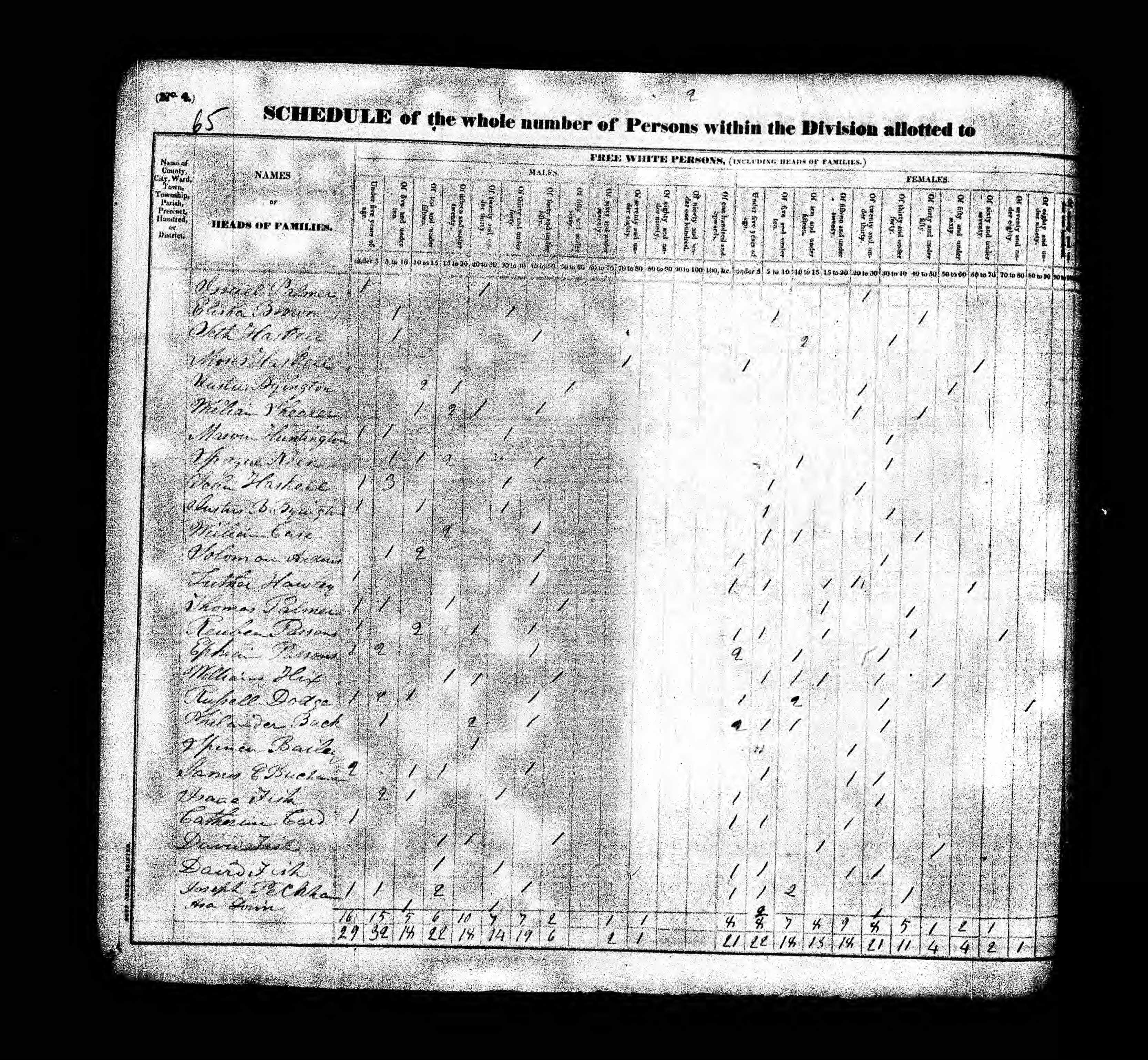
- 1830 United States Federal Census > New York > Cortland > Cortlandville > Name:
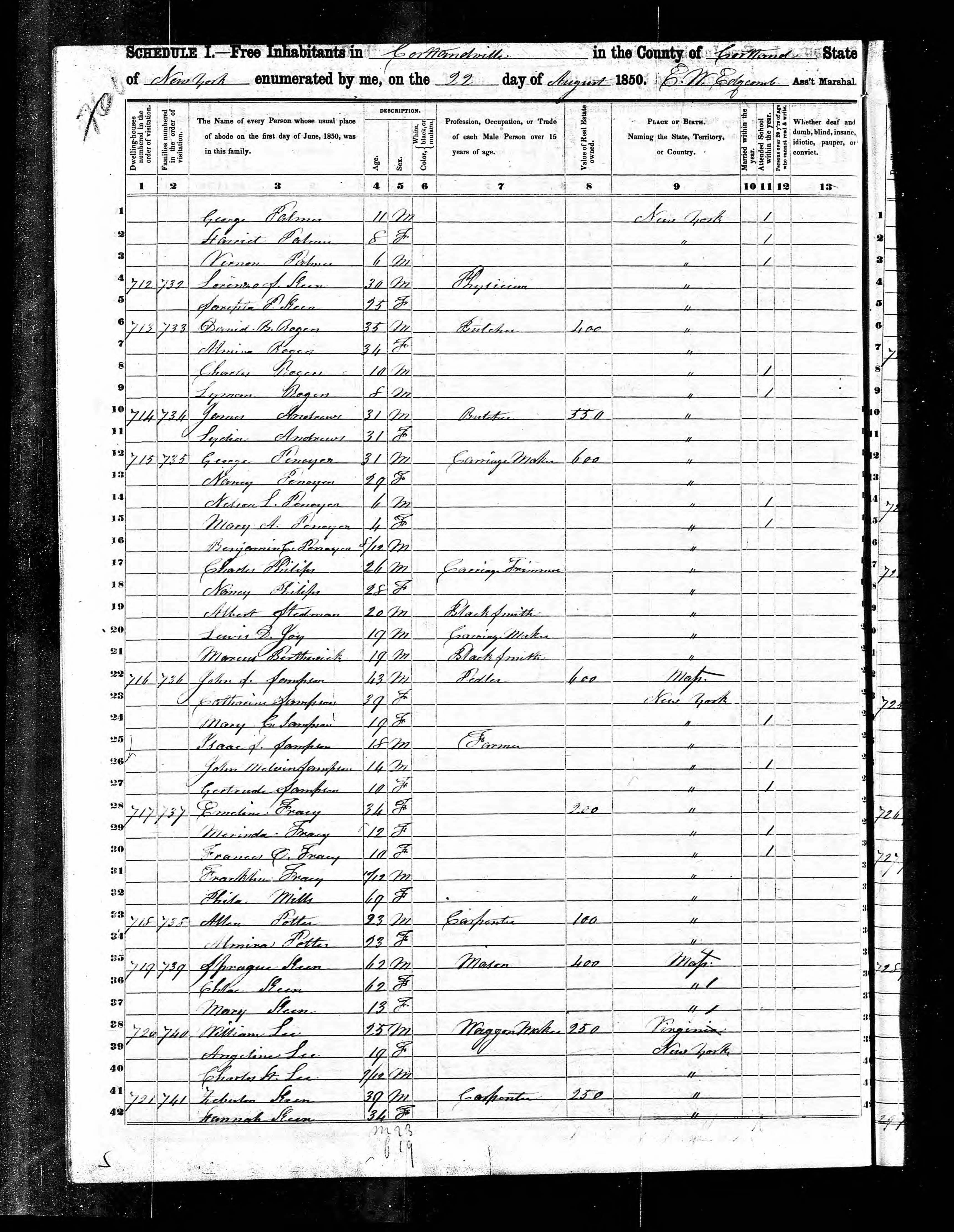
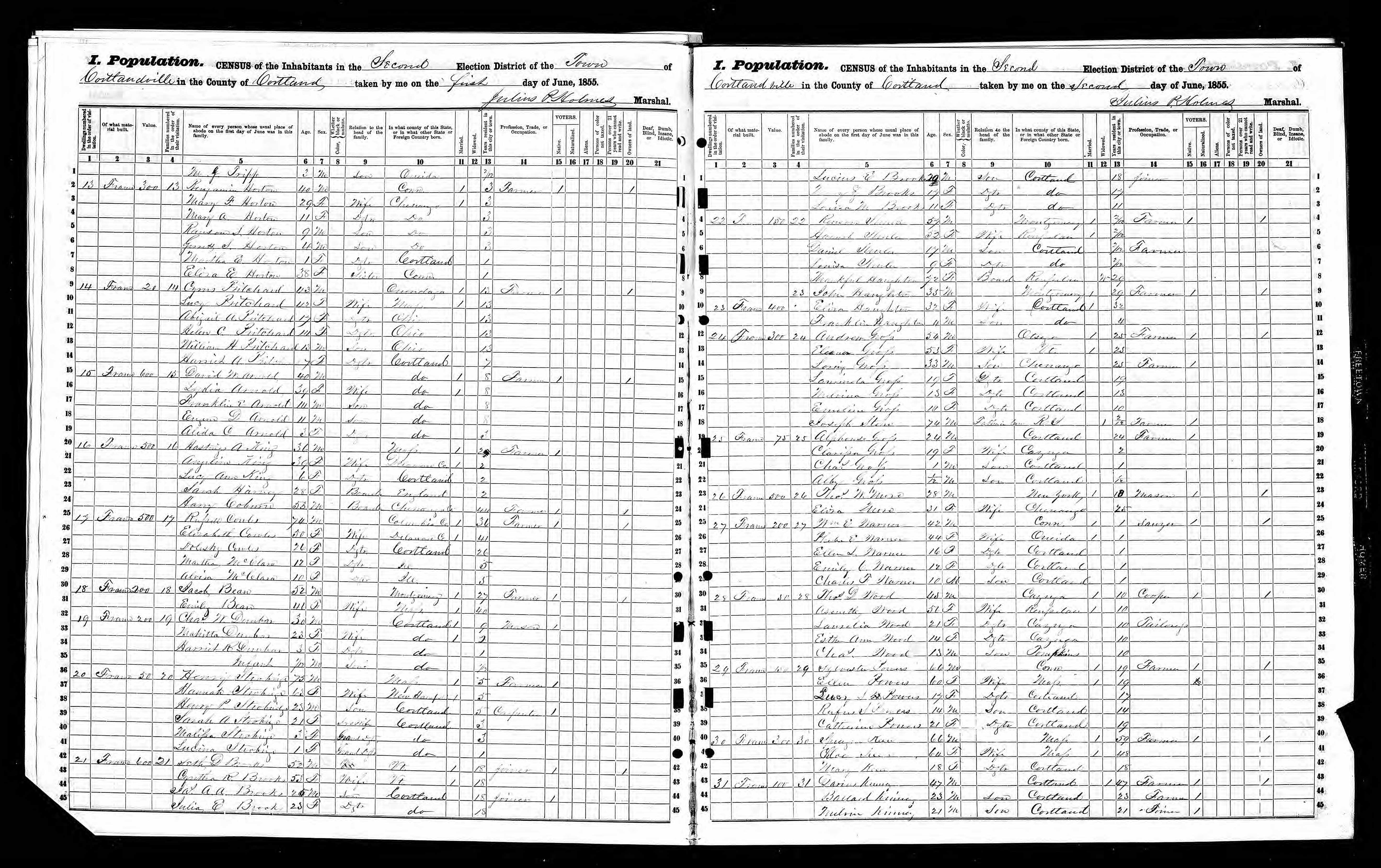
Spague Keen; Home in 1830 (City, County, State): Cortlandville, Cortland, New York; Free White Persons – Males – 5 thru 9: 1; Free White Persons – Males – 10 thru 14: 1; Free White Persons – Males – 15 thru 19: 2; Free White Persons – Males – 40 thru 49: 1; Free White Persons – Females – 10 thru 14: 1; Free White Persons – Females – 30 thru 39: 1; Free White Persons – Under 20: 5; Free White Persons – 20 thru 49: 2; Total Free White Persons: 7; Total – All Persons (Free White, Slaves, Free Colored): 7 - 1850 United States Federal Census > New York > Cortland > Cortlandville >Name; Sprague Keen: Gender; Male: Race; White: Residence Age; 62: Birth Date; abt 1788: Birthplace; Massachusetts: Residence Date; 1850: Home in 1850; Cortlandville, Cortland, New York, USA: Occupation; Mason: Industry; Construction: Real Estate; 400: Line Number; 35: Dwelling Number; 719: Family Number; 739: Inferred Spouse; Chloe Keen: Household members; Sprague Keen (62), Chloe Keen (62), Mary Keen (13)
- New York, U.S., State Census, 1855 > Cortland > Cortlandville > E.d. 2 > Name: Sprague Keen; Gender: Male; Age: 66; Birth Date: abt 1789; Residence Date: 1855; Residence Place: Cortlandville, New York, USA; District: E.d. 2; Relation to Head: Head; Line Number: 40; Household members: Sprague Keen (66), Chloe Keen (64), Mary Keen (18)
- 1860 United States Federal Census for Sprague Keene, Indiana > Porter > Center > Name: Sprague Keene; Age: 72; Birth Year: abt 1788; Gender: Male; Race: White; Birth Place: Massachusetts; Home in 1860: Center, Porter, Indiana; Post Office: 0; Dwelling Number: 464; Family Number: 452; Occupation: Farmer; Real Estate Value: 1000; Personal Estate Value: 50; Inferred Spouse: Cloy Keene; Household members: Timothy Keene (35), Susan Keene (32), Andrew Keene (10), Brayton Keene (3/12), Sprague Keene (72), Cloy Keene (70)
Footnote
- Many online trees incorrectly identify Sprague Keene’s mother as Hulda J. Stone (1766–1849), but no historical record supports this claim. The error appears to stem from a superficial name similarity and the widespread recycling of unsourced online pedigrees. In contrast, every reliable Keene genealogy — including the 1971 John Keen(e) and Associated Families, early Cortland County histories, and the internal naming patterns of the Keene family — identifies Sprague’s mother as Hulda (Sprague) Keene, wife of Zebulon Keene (1758–1828). Sprague himself confirms the family’s Massachusetts origins and 1795 migration to Homer, New York, a pattern that matches the Sprague family but has no connection to the Stone family of Connecticut and Pennsylvania. No census, probate, church record, land deed, or contemporary document ever places a woman named Hulda Stone in association with Zebulon Keene. The attribution of a Stone mother is therefore a modern genealogical error, contradicted by all primary and authoritative secondary sources.
Relation of Sprague Keen to Steven Barry Staggs: 4th great-grandfather
Page last updated June 26, 2026
Search the Staggs Family History site