BIRTH: 16 Jan 1726, Rochester, Ulster, New York, USA
DEATH: 5 Dec 1822, Johnstown, Fulton, New York, USA
FATHER: Frederick Schoonmaker (1692–1778)
MOTHER: Eva Swartwout (1694–1775)
SPOUSE: Sampson Sammons (1722–1796)
When Rachel Schoonmaker was born on November 22, 1726, in Rochester, New York, her father, Frederick, was 34, and her mother, Eva, was 32. She married Sampson Sammons in 1750. They had nine children in 16 years. She died on December 5, 1822, in Johnstown, New York, at the impressive age of 96, and was buried in Mohawk, New York.
A Life in Two Worlds
The winter sun had barely risen over the Shawangunk Ridge when Rachel Schoonmaker came into the world on 16 January 1726, in the Dutch hamlet of Rochester in Ulster County. The Schoonmakers were a family of deep roots—farmers, deacons, and landholders whose names filled the registers of the Kingston Dutch Reformed Church. Her father, Frederick Jochemsen Schoonmaker, carried the quiet authority of a man whose family had been in New Netherland since the 1650s. Her mother, Eva Swartwout, came from a line equally old, equally Dutch, equally stubborn in its traditions.
Rachel grew up in a world where the Dutch language flowed as easily as the Rondout Creek, where the rhythms of life were marked by baptisms, harvests, and the tolling of the Kingston church bell. She learned early the work of a frontier household—spinning, tending the garden, helping her mother prepare the great kettles of soap and dye. Yet she also absorbed the sturdier lessons: how to endure, how to keep a family together, how to hold fast when the world shifted around you.
Those lessons would serve her well.
A Marriage That Changed Her World
In 1750, Rachel married Sampson Sammons, a young man from the Mohawk Valley whose family had begun pushing northward into the frontier lands of Tryon County. He was older than she was, seasoned by the hard work of clearing land and building a homestead in a region where Dutch farms stood beside Mohawk villages and where the British Crown still struggled to impose order.
Their marriage joined two old Dutch families, but it also joined two landscapes—Ulster County’s settled farms and the raw, rising frontier of the Mohawk Valley.
By the late 1760s, Rachel followed her husband north, leaving behind the familiar stone houses of Ulster County for the wide, fertile flats along the Mohawk River. The move was not small. She brought with her children, household goods, and the weight of leaving the place where her family had lived for generations. But she also brought resolve. The Sammons homestead at Caughnawaga needed a matriarch, and Rachel stepped into that role with the quiet strength that defined her life.
Mother of Nine
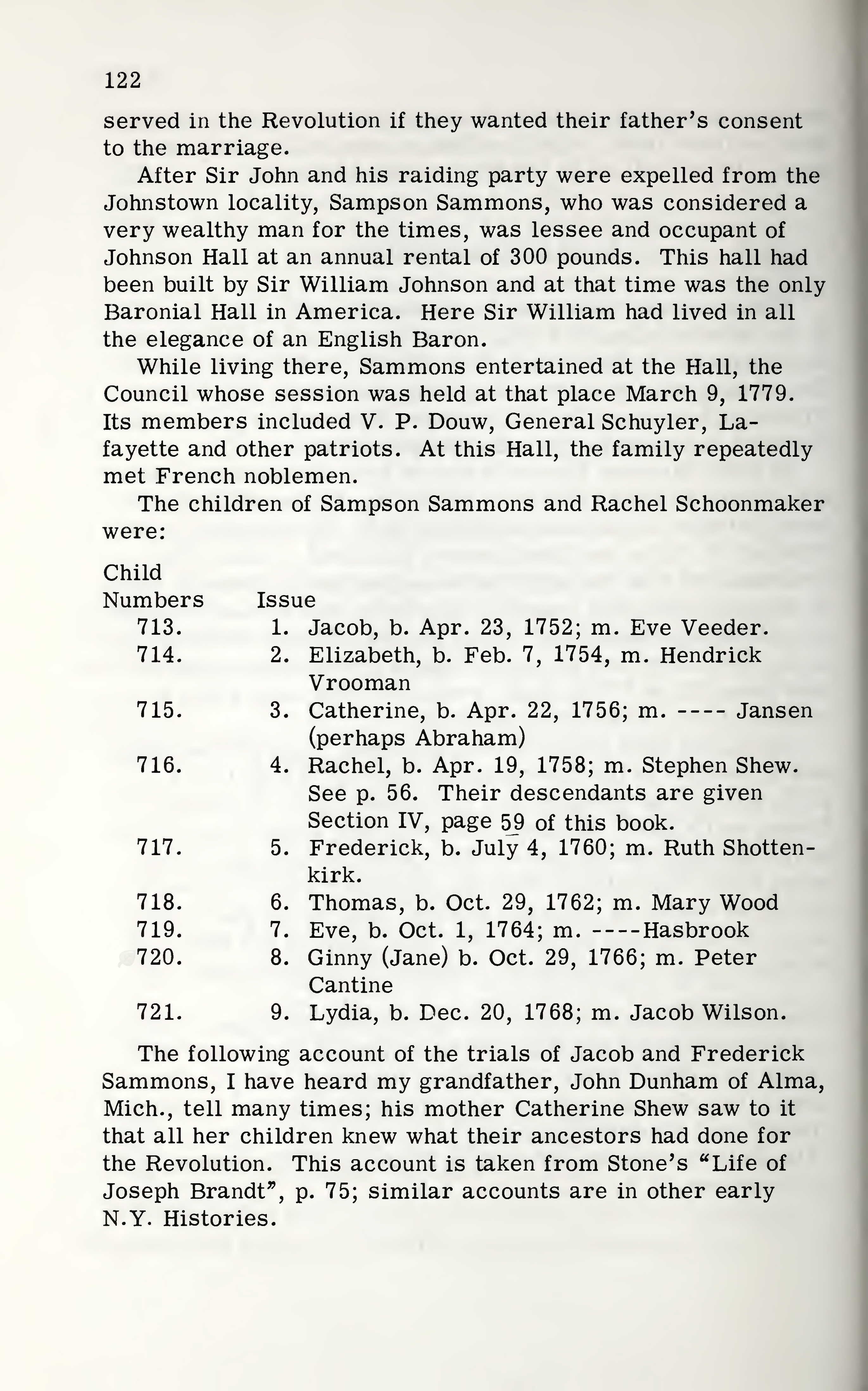
Between 1752 and 1768, Rachel bore nine children, each one baptized in the Dutch Reformed faith, each one raised in a household where Dutch customs persisted even as English influence grew. Her children—Jacob, Elizabeth, Catalyntje, Rachel, Thomas, Eva, Frederick, Janetie, and Lydia—would become the foundation of the Sammons lines that spread across Montgomery, Fulton, and Herkimer Counties.
Her sons grew into farmers, soldiers, and community leaders. Her daughters married into other Dutch families, weaving the Schoonmaker and Sammons bloodlines into the fabric of the Mohawk Valley.
Rachel’s household was large, noisy, and industrious. She managed it with the same steady hand her mother had shown before her. She kept the loom busy, the dairy full, and the children clothed in homespun. She taught them their prayers in Dutch, even as English crept into the valley’s schools and courts.
The Revolution Comes to the Mohawk Valley
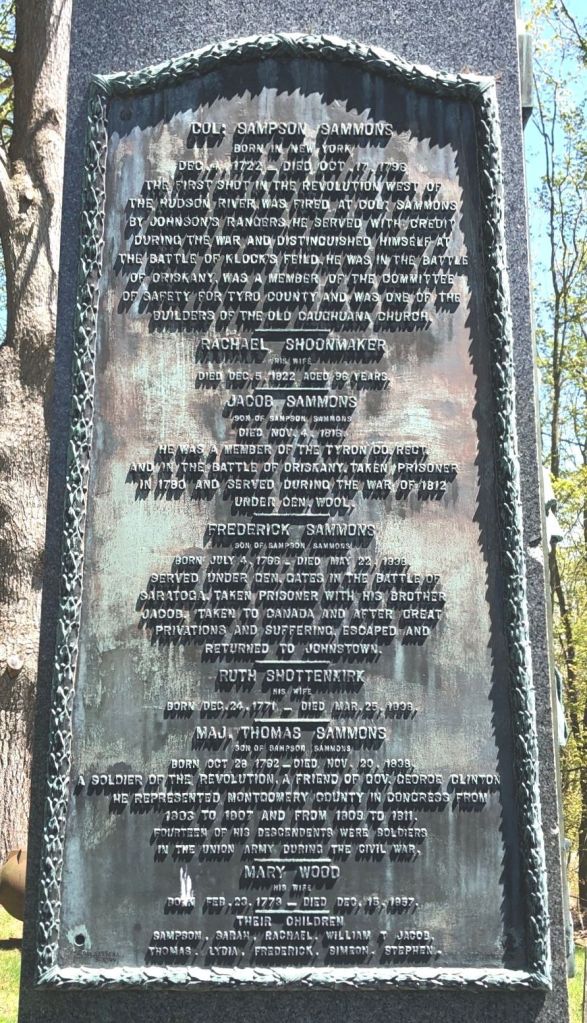
When the American Revolution erupted, the Mohawk Valley became one of its most dangerous frontiers. Sampson Sammons—already respected in the region—served on the Tryon County Committee of Safety, a body that risked everything by openly opposing British authority.
Rachel’s home became a target.
Raids swept through the valley. Farms burned. Neighbors disappeared. The Sammons family endured imprisonment, threats, and the constant fear of attack. Rachel, like so many frontier women, kept the household alive while the men defended the valley.
She lived through the night when her husband and sons were taken prisoner. She lived through the long months of uncertainty that followed. And she lived to see them return.
Her resilience was not recorded in military rolls or pension files, but it was no less real. The Revolution was fought not only by soldiers but by the women who kept families intact when the world around them fractured.
A Long Life in a New Nation
After the war, Rachel watched the Mohawk Valley rebuild. She saw her children marry, her grandchildren born, and the frontier she had once entered as wilderness become a settled American landscape.
She outlived her husband by twenty-six years.
By the time she died on 5 December 1822, at the remarkable age of 96, the world she had been born into—Dutch, colonial, provincial—had vanished. In its place stood a new nation, one her family had helped to secure.
Rachel was buried in the Sammons Cemetery, surrounded by the family she had raised and the valley she had helped anchor through war, hardship, and change.
Legacy of Rachel Schoonmaker
Rachel Schoonmaker’s life was not marked by public office or military rank. Her legacy was quieter but no less enduring:
- She carried Dutch colonial traditions into the American era.
- She raised nine children who became the backbone of the Sammons lines.
- She endured the upheaval of the Revolution on one of its most dangerous frontiers.
- She lived nearly a century, bridging the world of New Netherland and the early United States.
Her story is the story of thousands of Dutch‑American women whose strength shaped the Mohawk Valley—but hers is preserved in the genealogies, church records, and family histories that still bear her name.
Parents
FATHER: Frederick Schoonmaker (1692–1778)
MOTHER: Eva Swartwout (1694–1775)Married
Sampson Sammons (1722–1796)
Children
- Jacob Sammons (1752–1815) married Eva Veeder (1761–1834)
- Elizabeth Sammons (1754–1817) married Hendrick H Vrooman (1754-1815)
- Catalyntje Sammons (1756–1823) married Abraham Jansen (1757–1826)
- Rachel Sammons (1758–1800) married Stephen Shew (1761–1843)
- Frederick Schoonmaker Sammons (1760–1838)
- Thomas S Sammons (1762–1838) married Ruth Shottenkirk (1777–1838)
- Eva Sammons (1764–?) married —- Hasbrouck
- Jane Sammons (1766–1836) married Peter A Cantine (1765–1843)
- Lydia Sammons (1768–1799) married Jacob Wilson (1764-1838)
Documents
- Birth Records
- Find a Grave > Birth: 22 Nov 1726, Accord, Ulster County, New York, USA
- Marriage records
- Hudson-Mohawk Genealogical and Family Memoirs, Vol. III, Hudson-Mohawk Family Histories > Sampson Sammons married, in Ulster county, Rachel Schoonmaker, baptized January 16, 1726, died December 5, 1822. She was of the fourth generation of the Schoonmakers in America, descended from Hendrick Jochemson Schoonmaker, a native of Hamburg, Germany.
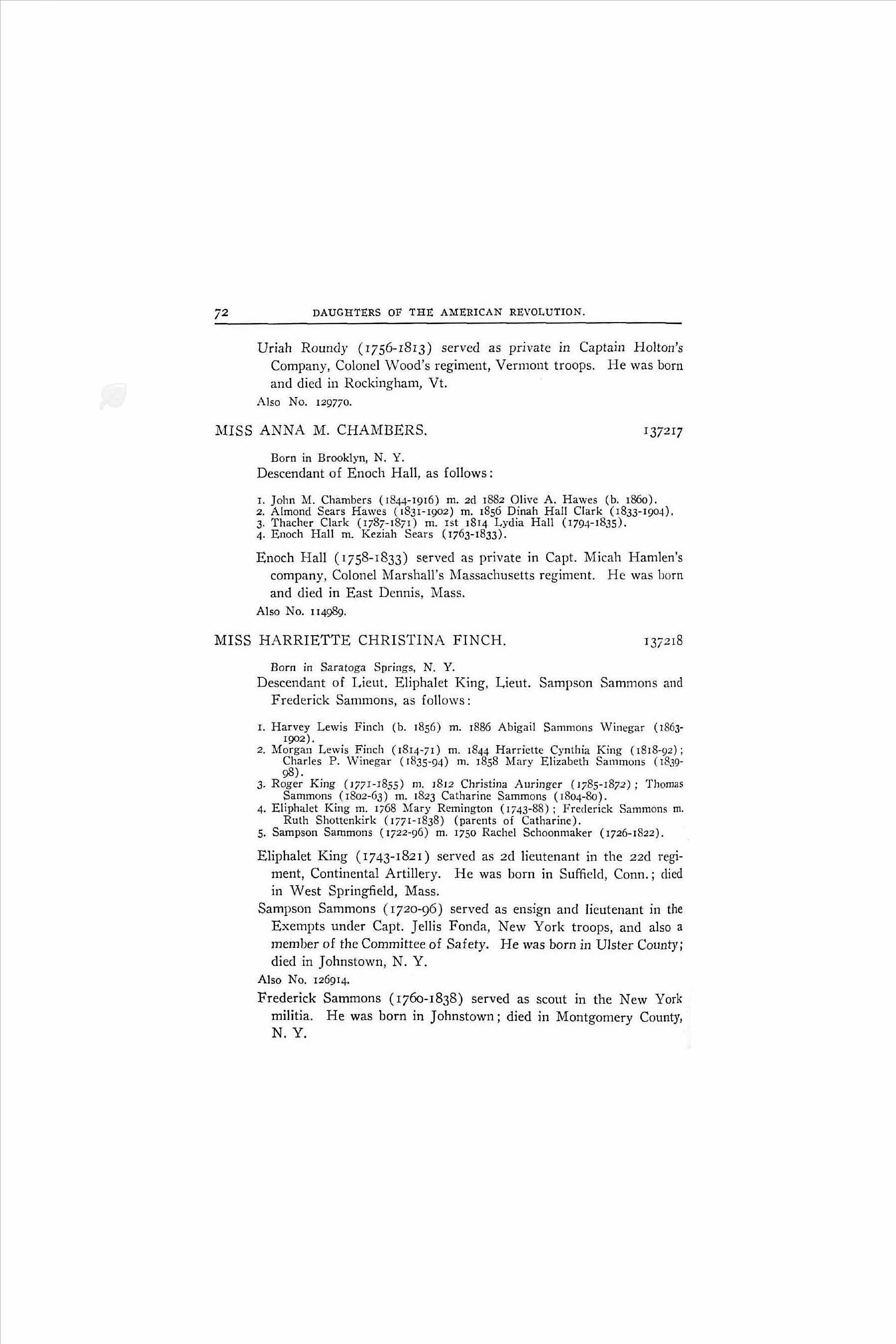
- Daughters of the American Revolution Lineage Book NSDAR Volume 138 1918 > Sampson Sammons (1720–96) m. 1750 Rachel Schoonmaker (1726-1822).
- Death records
- Find a Grave > Death: 5 Dec 1822 (aged 96), Johnstown, Fulton County, New York, USA
- Cemetery: Sammons Cemetery
- Burial Place: Mohawk, Montgomery County, New York, United States of America
- Other
- Hudson-Mohawk Genealogical and Family Memoirs, Vol. III, Hudson-Mohawk Family Histories > Sampson Sammons married, in Ulster county, Rachel Schoonmaker, baptized January 16, 1726, died December 5, 1822. She was of the fourth generation of the Schoonmakers in America, descended from Hendrick Jochemson Schoonmaker, a native of Hamburg, Germany.
- U.S., Family History Books > Children of Sampson Sammons and Rachel Schoonmaker
Relation of Sampson Sammons to Steven Barry Staggs: 5th great-grandmother
Page last updated May 2, 2026
Search the Staggs Family History site