BIRTH: 1657, Marshfield, Massachusetts, USA
DEATH: 23 Dec 1732, Pembroke, Massachusetts, USA
FATHER: Josiah Keene (1620-1710)
MOTHER: Abigail Little (1634-1657)
SPOUSE: Lydia Baker (1659-1732)
When Josiah Keen was born in 1657 in Marshfield, Massachusetts, his father, Josiah, was 37 and his mother, Abigail, was 23. He married Lydia Baker in 1682 in Duxbury, Massachusetts. They had ten children in 20 years. He died on December 23, 1732, in Pembroke, Massachusetts, having lived a long life of 75 years.
The life of Josiah Keen Jr
A Life Between Colony and Commonwealth
Josiah was born in 1657 in Duxbury, Massachusetts, a town carved out by the second generation of Plymouth settlers. His father, Josiah Keene (1620–1710), had grown up in the shadow of the Mayflower landing. His mother, Abigail Little (1634–1657), was the daughter of Thomas Little and Anna Warren, granddaughter of Richard Warren, one of the original Mayflower passengers. Abigail died the same year Josiah was born, leaving him motherless as an infant.
Josiah’s childhood unfolded in a blended household. His father remarried Hannah Dingley, and Josiah grew up among half‑siblings, extended family, and the tight-knit community of Duxbury. The Littles, Warrens, Bakers, Winslows, and Keens were all families whose names appeared frequently in town records — families who intermarried, traded land, served in local offices, and shaped the early identity of Plymouth Colony.
Marriage and Family
On 18 February 1682, Josiah married Lydia Baker (1659–1732), daughter of Samuel Baker and Eleanor Winslow. Through Lydia, Josiah’s children inherited the Winslow line — a family deeply rooted in Plymouth’s civic and religious life. Their marriage joined two powerful colonial families: the Little–Warren line on Josiah’s side and the Baker–Winslow line on Lydia’s.
Josiah and Lydia settled first in Duxbury and later in Pembroke, raising a large family whose names appear repeatedly in church registers, land deeds, and probate files. Their children included:
- Benjamin (1682)
- Josiah (1683, died young)
- Abigail (1685)
- Eleanor (1687)
- Lydia (1690)
- Nathaniel (1692)
- Bethiah (1694)
- Samuel (1694–1777)
- Isaac (1698)
- Hezekiah (1702)
These children married into families such as Soule, Thomas, Cole, Bisbee, and Leavitt — names that appear throughout Plymouth County’s records and that would carry the Keen line into the Revolutionary era.
A Yeoman of Pembroke
By the early 1700s, Josiah had become a yeoman of Pembroke,1 managing land inherited from his father and acquired through marriage. His name appears in deeds involving the Littles, Winslows, and Bakers — families with whom he shared both ancestry and community ties.
He lived through the transition from Plymouth Colony to the Province of Massachusetts Bay, witnessing the end of the colonial era and the beginning of the imperial period that would eventually lead to the American Revolution. His children and grandchildren would live in a world shaped by the conflicts and transformations he saw beginning.
His Will: A Window Into His World
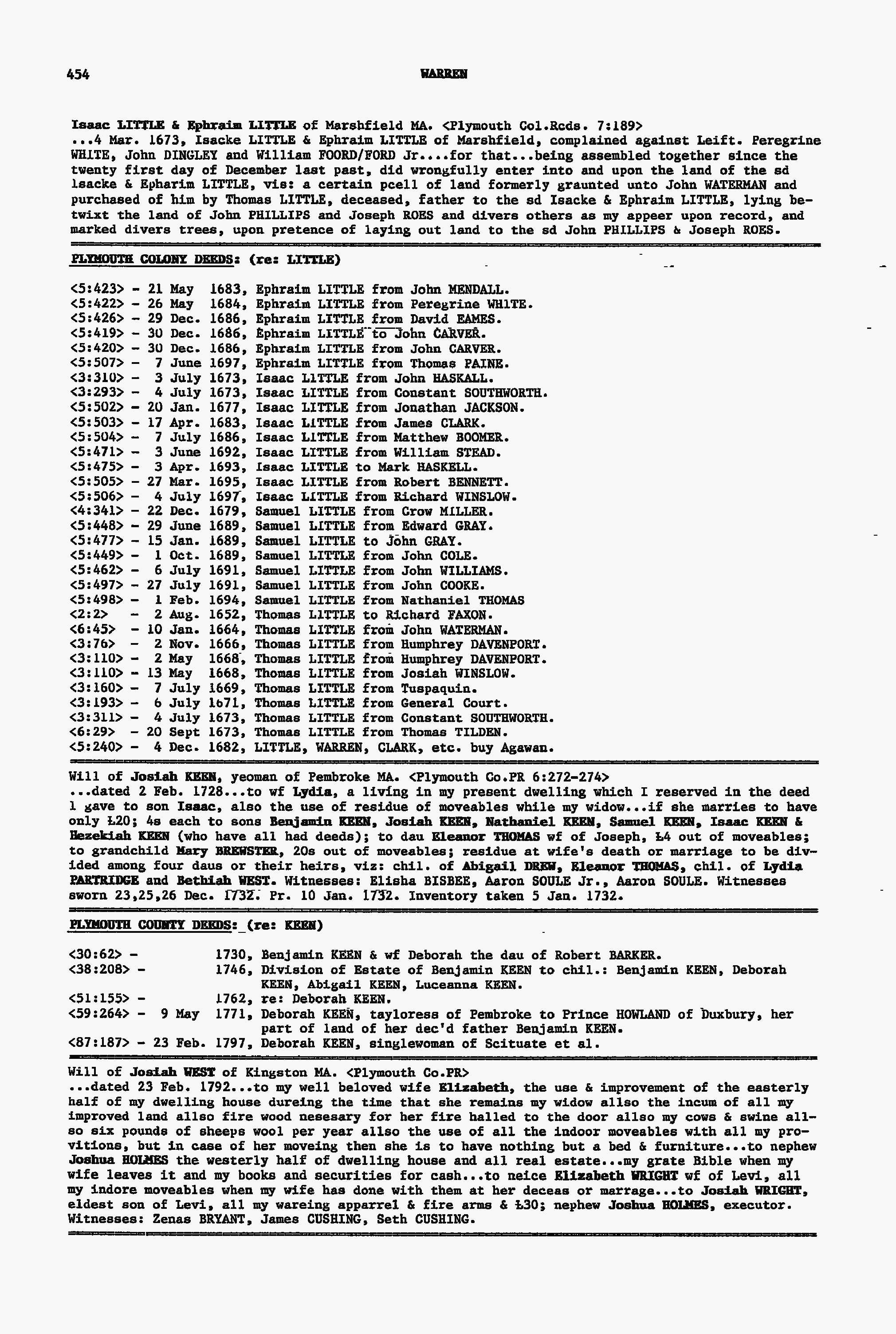
Josiah’s will, dated 2 February 1732, is one of the most important documents in the Keen family history. Preserved in Plymouth County Probate (6:272–274) and in Mayflower Deeds & Probates, it names nearly all of his children and confirms the structure of his household.
In it, Josiah:
- provides for his wife Lydia
- names his sons Benjamin, Josiah, Nathaniel, Samuel, Isaac
- names his daughters Eleanor Thomas, Lydia Soule, Abigail Keen
- names his granddaughter Mary Keen
- describes property previously deeded to his son Isaac
- orders equal division of the estate among daughters after Lydia’s death
The witnesses — Elisha Bisbee, Aaron Soule Jr., and Aaron Soule — tie the Keen family to the Bisbee and Soule families, both of which appear again in later Keen marriages.
Josiah died later that year, and his will was proved on 10 January 1732/3. Lydia died the same year, closing the chapter on one of Pembroke’s foundational families.
The following is an excerpt from Staggs Genealogy – Harold Wareham Staggs – His Book
Grandfather Josiah Jr. (1660) was Josia and Anna’s son. He met and wed Lydia Baker. They had eleven children and lived in Pembroke.
The early history of the Keens and information about his children came to us from the “account book” of Hezekiah Keen who was the eleventh child of Josiah Jr. and Anna. This book was given to the Massachusetts Society of Mayflower Descendents by Abon Keen.
Grandmother Linda Baker was the daughter of Samuel Baker whose mother was Ellen or Eleanor Winslow (about 1637). Her father was Kenelm Winslow (1599) who came from England to Plymouth in 1629; admitted freeman 1632; surveyor of Plymouth; original proprietor of Assonet (Freetown) 1659; engaged in the settlement of Yarmouth; member of Marshfield military company.
Looks as if he was one of our more energetic ancestors.
Josiah’s ninth child was Grandfather Samuel Keen who married Ruth Sprague. They had [six] children.
The following is an excerpt from The John Keen(e) (1578-1649) and Associated Families, by Mr. and Mrs. Archie Timothy Keene, 1971
Josiah married Lydia, daughter of Samuel and Elinor (Winslow) Baker, He died 12-23-1732, resident of Pembroke. They had eleven children.
Legacy of Josiah Keen Jr
Josiah Keen Jr.’s legacy is carried in the families that grew from his marriage to Lydia Baker. Through him, the Keen line inherited:
- Mayflower ancestry through Abigail Little and Anna Warren
- Winslow ancestry through Lydia Baker
- Baker family heritage through Samuel Baker
- Dingley connections through his stepmother
- Soule, Thomas, and Bisbee ties through his children’s marriages
His children spread across Plymouth County, establishing branches in Pembroke, Kingston, Marshfield, and later Maine. His son Samuel Keen became the patriarch of the large Keen–Sprague–Redding family, and his grandson Isaiah Keen served in the Revolutionary War.
Josiah’s life bridged the earliest days of Plymouth Colony and the dawn of the American nation. His will stands as a rare, detailed record of a 17th‑century family transitioning into the 18th century — a document that preserves not only names and relationships but the structure of a household that carried Mayflower blood into the Revolutionary era.
Through his descendants, Josiah Keen Jr. became the ancestor of farmers, soldiers, town officers, and lineage society members. His story is quiet, but his legacy is vast.
Parents
Father: Josiah Keene (1620-1710)
Mother: Abigail Little (1634-1657)
Married
Married Lydia Baker (1659-1732) in 1682, Duxbury/Scituate, Massachusetts
Children
- Benjamin Keen (1682–1732) married Deborah Barker (1685-1771)
- Josiah Keen (1683–1767)
- Abigail Rebecca Keen (1685–1717)
- Eleanor Keen (1687–1724) married Joseph Thomas (1680-1732)
- Lydia Keen (1690–1728) married Aaron Soule (1688-1765)
- Nathaniel Keen (1692–1765) married Abigail —- (1695-1760)
- Bethiah Keen (1693–1745)
- Samuel Baker Keen (1694–1777) married Ruth Sprague (1701-1736)
- Isaac Keen (1698–1787) married Mary —- (c1700-Aft. 1732)
- Hezekiah Keen (1702–1770)
Documents
- Birth Records
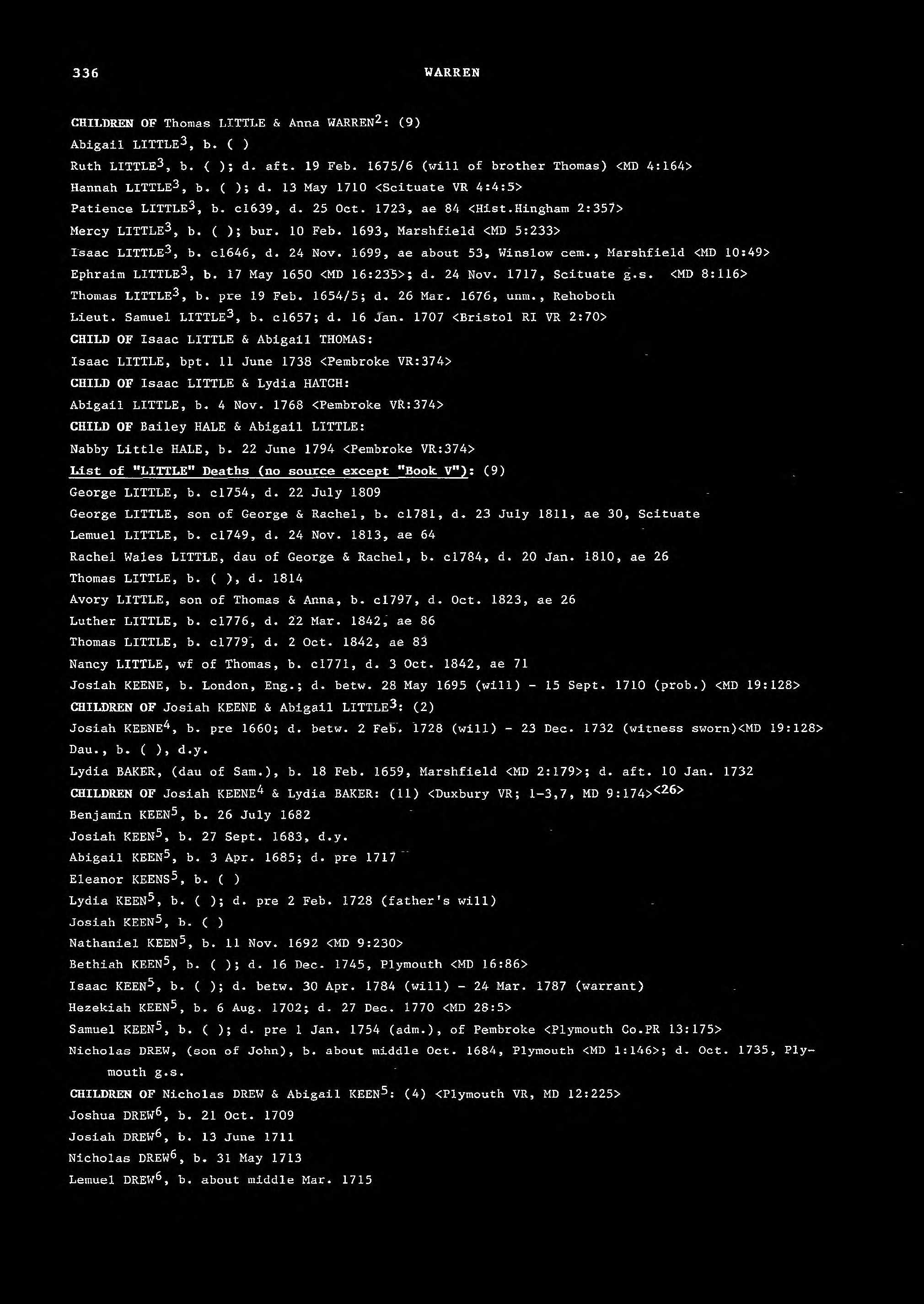
- Mayflower Births and Deaths, Vol. 2 > Warren > Josiah Keen
- Find a Grave Birth 1657, Marshfield, Plymouth County, Massachusetts, USA
- Marriage records
- U.S., New England Marriages Prior to 1700 > Name: Josiah Keen Jr; Gender: Male; Marriage Date: 1682; Marriage Place: New England, USA; Death Year: 1732; Spouse: Lydia Keen
- U.S. and International Marriage Records, 1560-1900 > Name: Josiah Keen; Gender: Male; Birth Place: MA; Spouse Name: Lydia Baker; Spouse Birth Place: MA; Spouse Birth Year: 1658; Marriage Year: 1681; Number Pages: 1
- Death records
- Mayflower Births and Deaths, Vol. 2 > Warren > Josiah Keen
- Find a Grave Death: 23 Dec 1732, Pembroke, Plymouth County, Massachusetts, USA
- Mayflower Deeds and Probates, 1600-1850 > Will of Josiah Keen; 2 Feb 1728, Plymouth County, Pembroke, Massachusetts, Probate Year 1732
- Other
- Mayflower Births and Deaths, Vol. 2 > Warren > Children of Josiah Keen and Lydia Baker
Footnote
- A yeoman in colonial Massachusetts was a free land‑owning farmer — someone who worked his own land, supported his household without servitude, and stood solidly in the middle tier of society. Unlike laborers or tenant farmers, a yeoman owned the property he lived on and managed, which gave him economic independence and social respectability. He was not part of the gentry or merchant elite, but he was considered a stable, responsible member of the community, eligible to serve on juries, vote in town affairs, and hold minor local offices. When a man like Josiah Keen Jr. is described as a “yeoman of Pembroke,” it means he was an independent landholder whose farm, tools, livestock, and household formed the backbone of the town’s everyday life — a man of modest means but solid standing, rooted in the land he passed on to his children.
Relation of Josiah Keen Jr to Steven Barry Staggs: 8th great-grandfather
Page last updated June 29, 2026
Search the Staggs Family History site