Ella Blanche (Wareham) Staggs
1961
Back in 1910 when our love was young, we left the East and settled in the little town of Roseburg, Oregon. Here nature’s landscapes were yet untouched by man. Forests were filled with deer and wild game. Streams alive with trout, while the rivers became the spanning beds for salmon. It was a forest primeval. Motor cars were few because of the lack of highways.
One old Stage Coach driver, who must have met one of those high-pressure salesmen, came into possession of an Inter-State car. This he decided would be an improvement over his four-horse team, so he converted his stage into a Motor Stage. But after a year, he with little mechanical experience was trying to interest someone in buying the car. My husband, Richard, a flour miller, knew something about gas engines and having an inquisitive nature and a never-failing spirit of adventure traded horses and harness for the car.
We had always enjoyed camping in the mountains or fishing on the banks of a river on weekends and holidays. Richard’s idea was to convert the Stage Coach into a camping contrivance, to be used in these occasions when we enjoyed weekend camping in the mountains or fishing on the banks of a river.
He first took off the rear seats of this stilted contraction and built a longer body. On the outside (on each side) of the car he attached two long boxes, with hinged covers. These to be used for food equipment and necessary things needed by our family of six. We had four small sons. The baby fifteen months, Richard seven, Bill six years, Hal four.
In the back and on the floor was room for little Bob and I to sleep, after removing trunk, at night. The top of this now antiquated car was braced, with rounded stairs, overhead and covered with a tarp, to protect us from those Oregon mists and desert suns. This was the covered wagon type used in all wagons in the mountains, so we called it our Covered Wagon and named it Betsy. It had the old carbine lights and the brakes were on the outside of the car (wagon type).
After a trial run, in Which Richard drove or coasted downhill (it refused to go up, so I had to run along beside the car) and thrust a rock behind a wheel until he could force another shot of gas, to lunge it another few feet further up the hill. This was not only a back breaking job but our patience was sorely tried and I have never heard such an eloquent speech on engines. We found later the gas was not feeding properly and we had to back the car up the hills.
If you can remember in 1910 these were few cars and fewer auto mechanics, so Richard purchased a book dealing with auto mechanics and with his study and with his I can do it disposition he finally became its master. What a time we had. People as well as horses, left the road, as this monstrous moving four wheeled car with noises following and gases trailing, sped by at ten miles an hour. Our first real trip was eighteen miles from Roseburg our home. It was rather hilly and (with unseen troubles) we did get there and camped on the bank of the Umpgua River, near the small-town Winchester. Here the master of my destiny staked our tent, cut ferns and pine boughs and placed them on the ground inside the tent. On the top of this he spread tarpaulin and then the bedding. He and the boys slept here, while the baby and I slept in the car.
The boys and I gathered wood and built a fire, arranged four rocks on which we placed a grate over the hot coals. It was not long until the trusty old iron skillet was filled with sizzling bacon after which came the sliced potatoes and soon they became a golden brown, followed by the eggs from my hens. Of course, the coffee pot (blackened by now) sent an aroma special to hunters and fishermen of the woods in a misty steam but not for long because the enamel cups were waiting. We carried a brown jug filled with (of course) milk for our young ones. Our camper had no refrigeration, so the chilly waters of the river never failed us. There are many times in these trips, when we had to park our camper at the end of a road and pack on into the mountains with a pack mule. On these adventures we killed our meat (deer) and roasted strips of venison on the campfires, such a flavor should not have been lost to the outside world. On these occasions I wore boys overalls and shirts, heavy boys shoes with cleats. This was a shocking attire in those days for a woman, but I had a practical husband.
When World War I was declared, we sold our business in Roseburg and in our covered wagon went to Powers Oregon, where the government was cutting and milling douglas fir, spruce and cedar for ships and planes. Here our tent was erected over a wood floor platform and attached to our camper. It was probably one of the first cabanas.
We had always loved nature but it was a rough way of life for one who had always lived in a town and enjoyed some conveniences. Here we had to depend on our fish, wild fowl and venison. We dried the venison and served it in a gravy as we had done with chipped beef. It was a wonderful life, with all the great out of doors, filled with the fragrance of the cedars and pines. Snow in the mountains above us. At night as the sun slid out of sight it was cold but we didn’t mind it. I’ll never regret those trying times because it was during the war.
My stove on the inside of the tent was used for baking. No bakeries here and remember back then we were rationed and with white flower we had to take so many corn substitutions. This with a chain smoking store and I a Hooser always having to bake com bread, which my husband a Southerner fairly drooled over and those growing boys who could eat anything, made me swear if ever I got into a house again I would never allow com meal in my home but I do once in a while bake corn gems, just to keep peace in the family.
When Armistice was signed in 1918, we decided to go back East where my parents lived. In 1919 our family was five and the Covered Wagon was to fill its longest and its last mission, over two thousand miles. Yes, I think we could have been called pioneer campers.
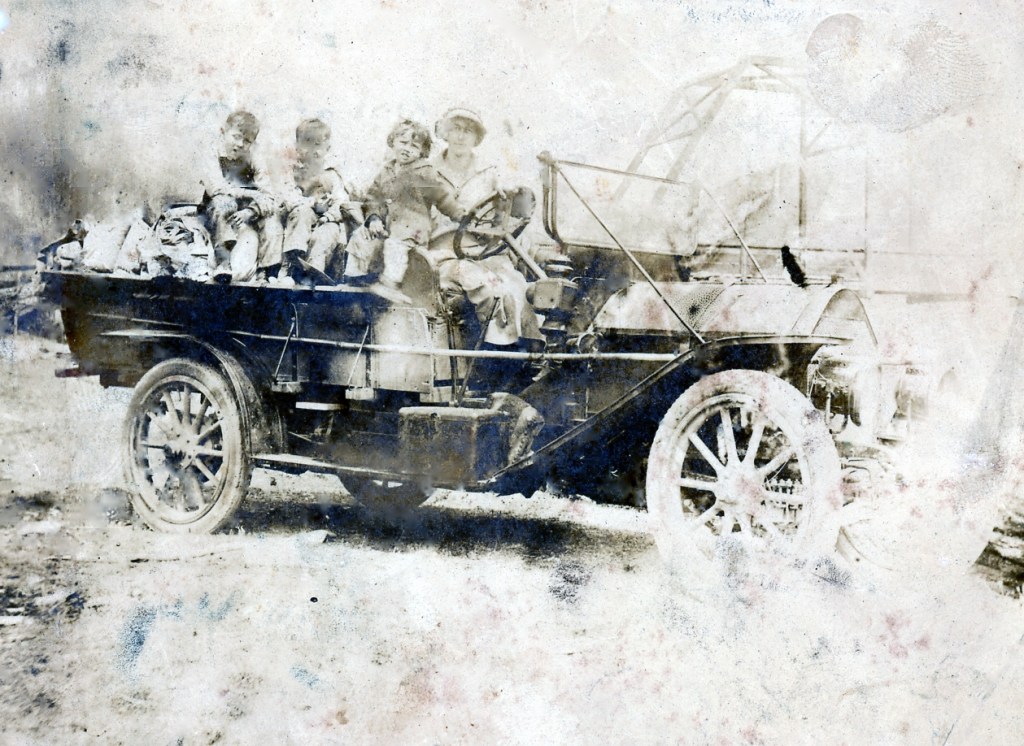
We took a trunk and some boxes of clothes. Our outside boxes on the outside of the car were crammed with canned fruit, vegetables, dried venison and as many staple food as we could store. We also carried our guns and fishing equipment to help furnish our food supplies. Our money had been used to buy War Bonds so the little we possessed must be reserved for gas, oil and urgent needs. Everyone told us we were crazy and as I look back it did seem a little unusual.
We plodded along, stopping by rivers, where I had to do the family washing Indian style on my knees and didn’t seem to take it too badly. Isn’t youth wonderful? What a trip. Baby and I slept in the camper and Richard and the three boys under the stars.
Crossing the American desert in 1919 took time and strength. If you only could have seen these roads. But after thirty-three days on Aug 15th, we arrived three miles from Valparaiso, Indiana with the last tire beyond repair. My brother bundled us in his Ford and we arrived at my Mothers. Later we had our Covered Wagon put in a barn, where it rested until my husband found work with the Common Wealth Company in Chicago. After our trip there our faithful old camper had to be Junked. We had no place to store it. We lived in Chicago twenty-five years where we reared and educated five sons. The second world war took three sons who returned, but worries and ill health retired my husband Richard and we moved to Stella, Missouri. Here the doctor advised a warmer climate during the winter months.
The first winter was spent in cabins or hotels. These were comfortable but was not our conception of living. When the next winter rolled around Granddad (we are much older now) said, how would you like a trailer? Ever since the World’s Fair in Chicago, when I had feasted my eyes on that trailers display I had said, I hope someday we can take a trip in a trailer. I didn’t need to argue or take time to think, so far as I was concerned it was settled. I was sure I would like a home on wheels, where we could cook our own meals and sleep in our own beds.
Now Granddad started his search for a trailer. It was to be a used one but it must be in a good condition. We visited so many sales parks and saw so many trailers I turned it over to him for his project. One evening about midnight I heard the car pull into the driveway, there he was car and trailer too. He called, come out and see your new home. That was Richard.
The very next day he began its rejuvenation. It was in good condition but he went about cleaning polishing and with a new coat of paint she was alright and we were proud of her. There were three closets in this trailer so he, after moving a partition in this closet, installed a pullman toilet, such luxury.
When the leaves began to make colored patterns and the squirrels started gathering their winter supplies, we were ready to follow the birds, South. The morning arrived. We were up at dawn and the Packard was connected to our new appendage. After backing and starting and twisting and turning we were out of our driveway and on the highway.
I got into the car and eased down into my seat. Although I had tried to help in the manipulation of this newly acquired addition it was understood I was a complete failure when it came to giving directions on moving a trailer. I was glad the neighbors were still asleep, or were they? But the mood didn’t last long and the driver took off the brakes, gave her some gas, we were moving. I kept looking behind and it was always there.
Now Granddad said, after a sigh and a long silence here we are “home and all.” I finally relaxed. That night we pulled into a trailer park at Hot Springs, Arkansas. Here after some fancy twisting and maneuvering we eased her into our space, with every tree standing erect. The butane was turned on, water and electric and sewage connected. We unlocked the door to our new home and I was now ready to play at housekeeping. It was like taking a second honeymoon.
My dinner was a success and with dishes washed and stacked in their places. I knew everything must be kept in order. We slept well, had breakfast and was all hooked up in no time. We always double checked on our connections but this soon became a habit. We traveled to Biloxi Mississippi where the poinsettias were afire with their lovely rad leaves. Here on the gulf we enjoyed sunshine, beaches, sea food and peace. But the second day Granddad suffered a heart attack and was confined to his bed for a month. My, how thankful was to be in my own home on wheels, with convenience and quiet.
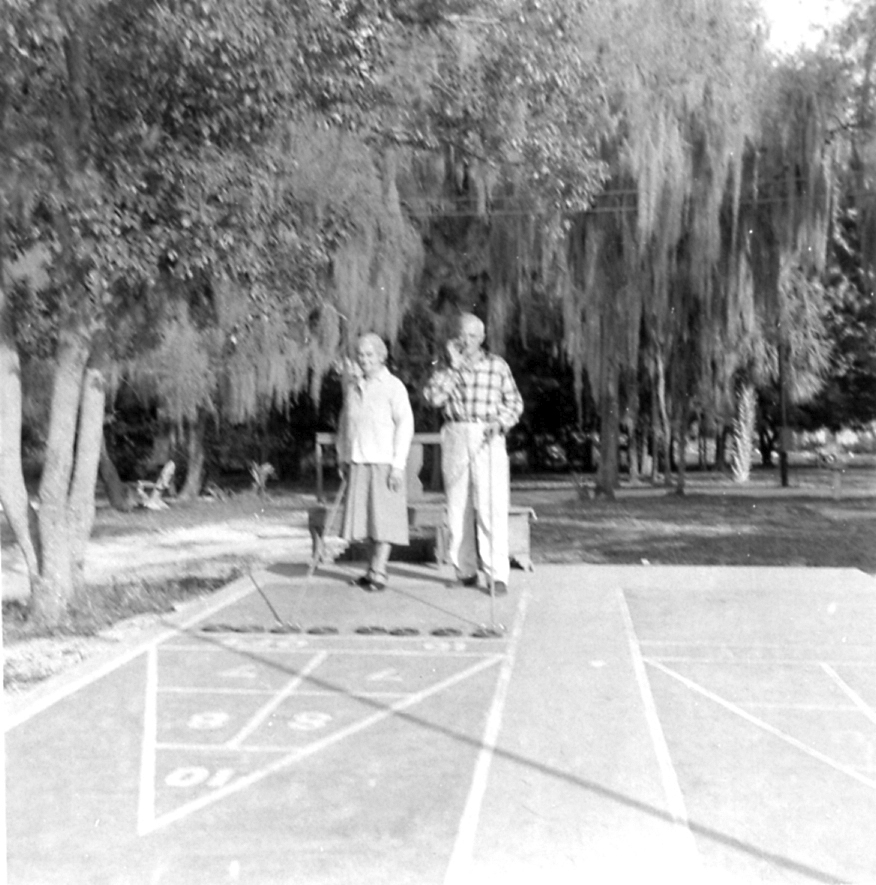
When he was able to be out of bed and could sit outside in the warm sunshine and read, we were happy. In April we went back home.
Since then we have made one trip into Texas and Mexico, another last summer we with two young grandchildren (Virginia and Natalie) and spent our summer in Yellowstone Park, natural Park California and Yosemite. One famous for lofty cliffs, waterfalls, big trees and magnificent scenery.
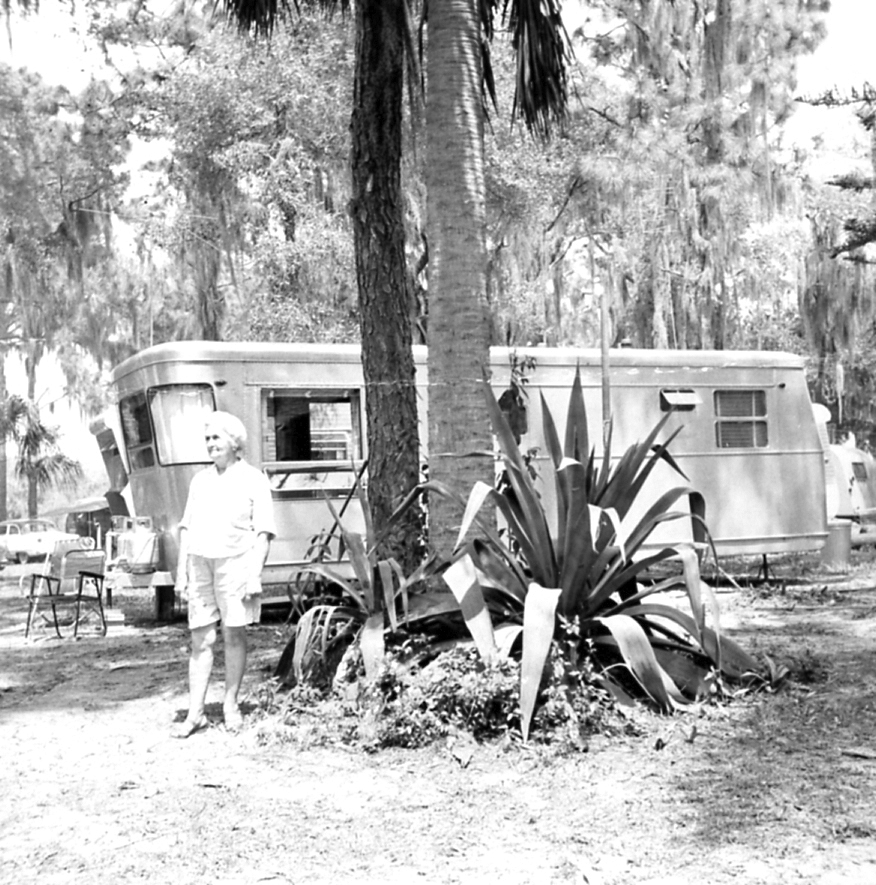
We have just returned after spending our winter in Florida traveling as for south as Key West. We like everything about this kind of life. At these trailer parks the trailerites are like a big family. You can find enjoyment in everything you do. Neighbors are most cordial and the park managers pleasant and cooperative. Granddad sure likes his shuffle board and after a few games I can see why.
We now have a lighter trailer but like a twenty-four. It is all aluminum. We are now deciding where to spend next winter and December will be rolling in our new home in wheels.
Gram
Mrs. R. L. Staggs
Stella, Mo
Written fifteen years ago
I will le 88 in April 18, 1976
Received $6.00 from Good Old Days Mag
Page last updated February 16, 2026
Search the Staggs Family History site

 Staggs Family History