BIRTH: 22 Oct 1848, Waldron, Missouri, USA
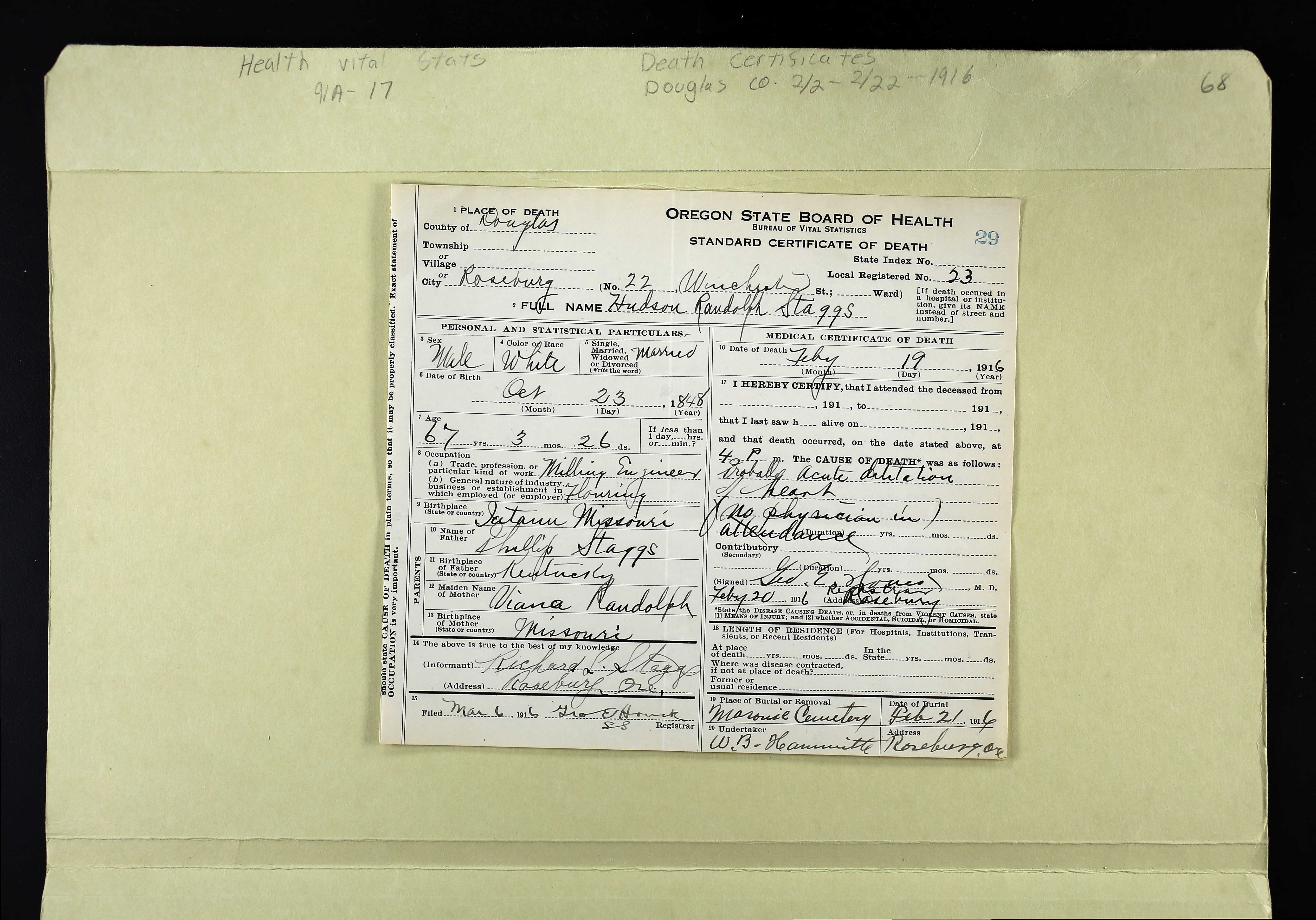
DEATH: 19 Feb 1916, Roseburg, Oregon, USA
FATHER: Philip Beard Staggs (1810-1850)
MOTHER: Vianna C Randolph (1819-1895)
SPOUSE: Ida Antha Stone (1861-1930)
When Hudson Randolph Staggs was born on October 23, 1848, in Waldron, Missouri, his father, Philip, was 38 and his mother, Vianna, was 29. At the age of 16 he enlisted and served as a bugler in the 14th Regiment, Missouri Cavalry of the Union Army during the Civil War. He married Ida Antha Stone, and they had four children together. He died on February 19, 1916, in Roseburg, Oregon, at the age of 67.
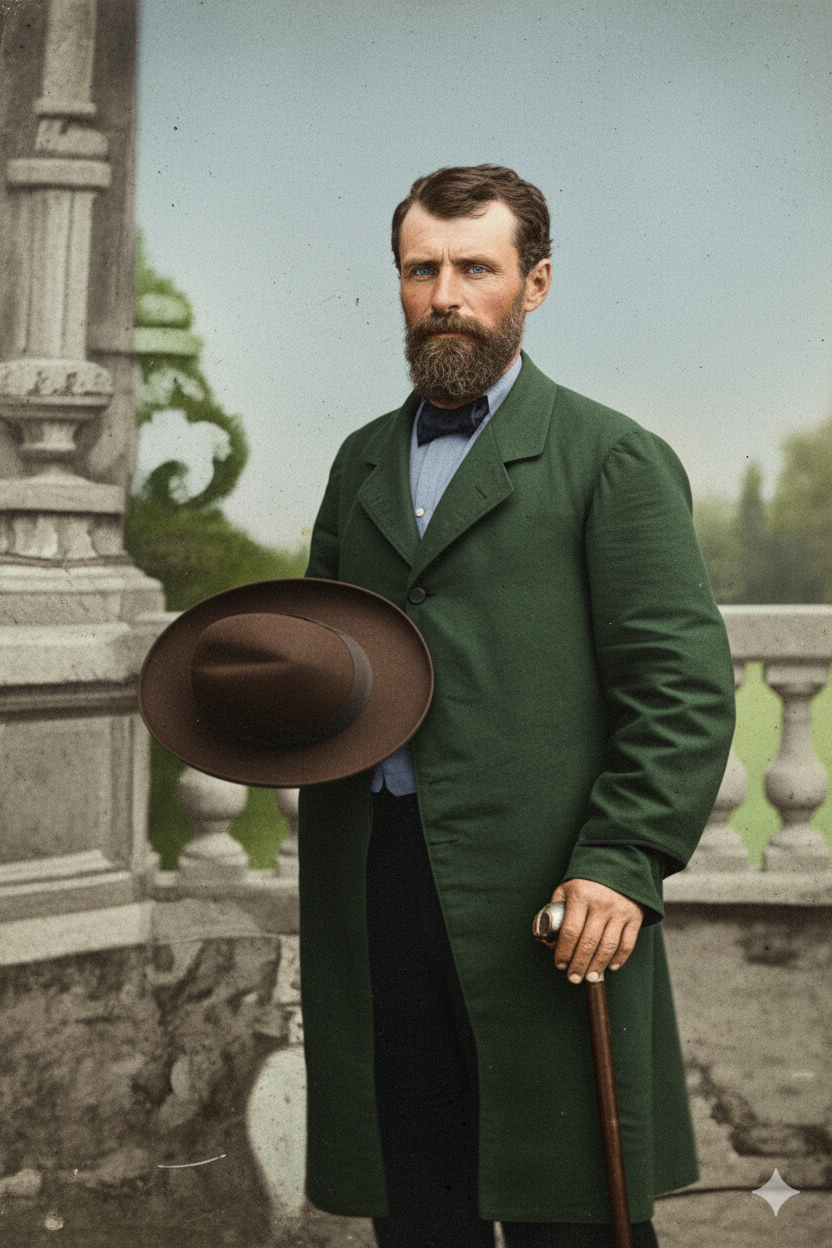
His story
The following is an excerpt from Staggs Genealogy – Harold Wareham Staggs – His Book
Hudson Randolph Staggs, my grandfather, was born in 1848 in Waldron, Platte County, Missouri. Phillip’s sixth child and next in our line.
That same year the population of San Francisco was 800 and gold was found at Sutter’s Mill.
Hudson was two years old when his father Phillip died. His half-brother and sisters were taken back to Kentucky to live with their uncles and his mother Vianna moved with her three children to Parkville, Missouri. When he was ten, his mother married Basil George but soon separated from him because of his drinking habit. She died in 1890 and is buried in Old Cemetery at Parkville. My Dad told me that she was part Choctaw1 and that during the Civil War she sold wild grass hay to the Union Army. Hudson received a good schooling as a boy and worked for his kin on their farms in Platte County.
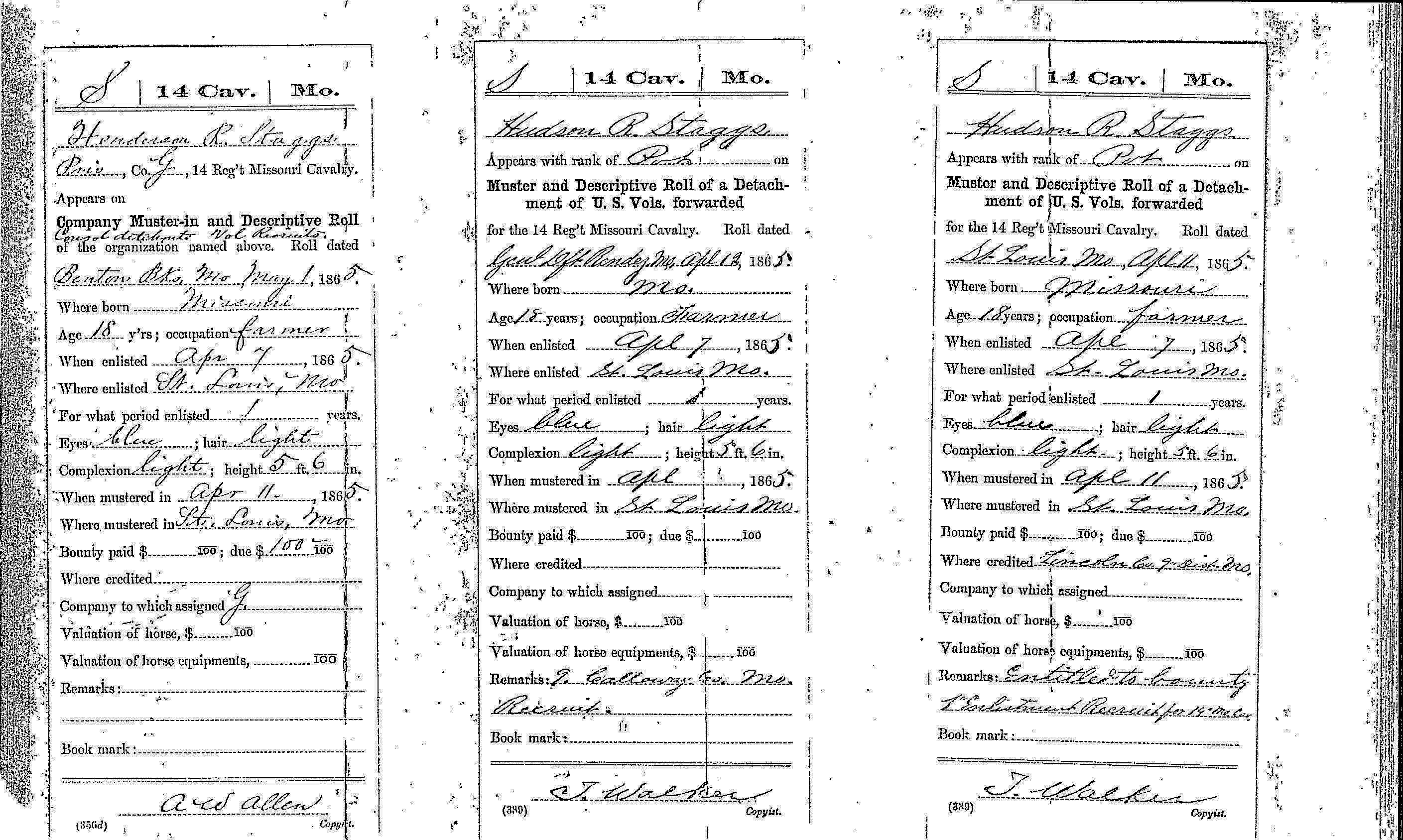
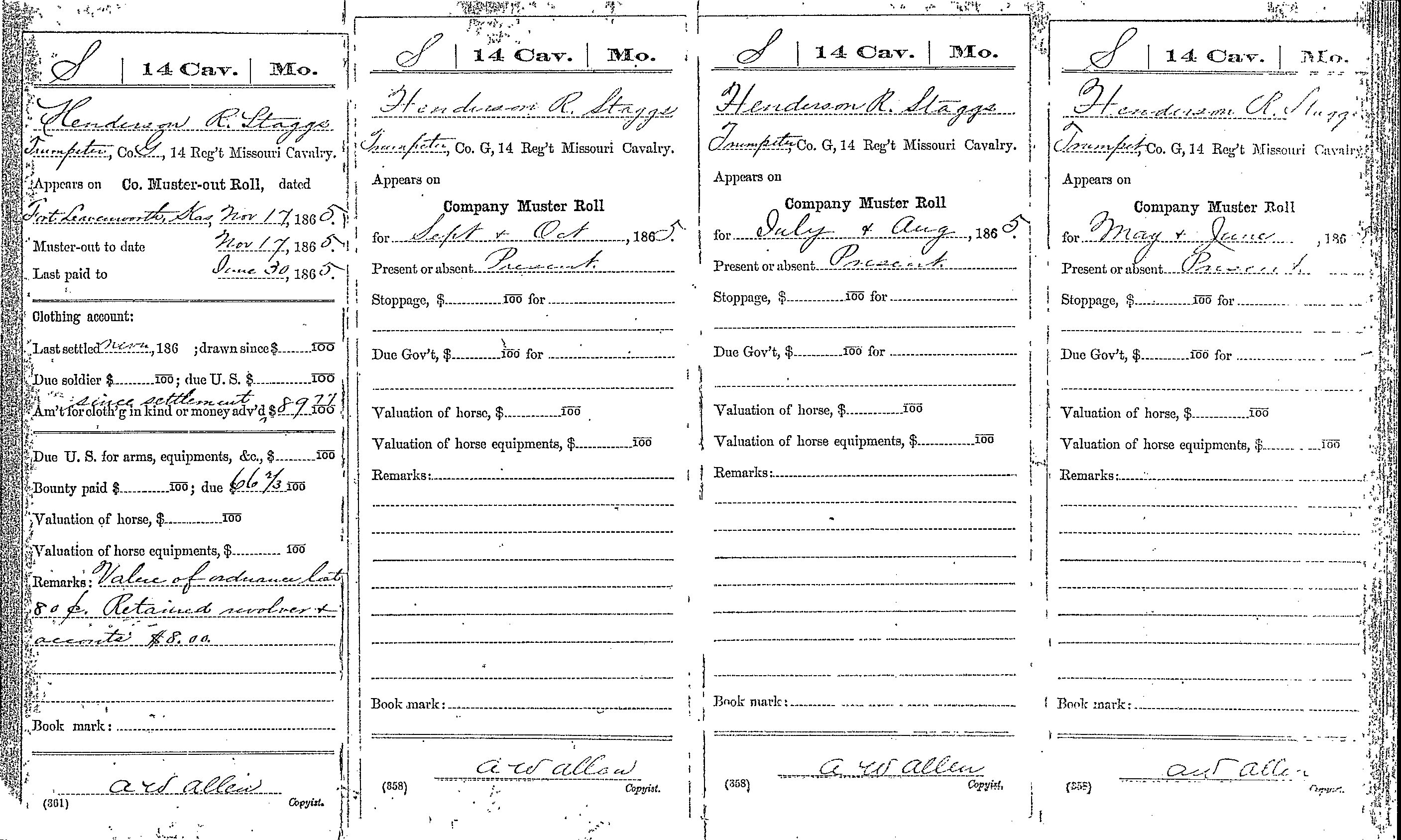
Dark days were coming to our country. The southern states were seceding from the Union. Hudson watched for a while then when he was seventeen (said he was eighteen)2 he went to the Benton Barracks and enlisted in the 14th Regiment, Missouri Cavalry of the Union Army.3 His papers show that he had blue eyes, fair complexion, 5 feet 6 inches tall and weighed 150. His training was at Fort Leavenworth, Kansas, his pay 40 cents a day. Although he qualified for both a bounty and pension for his wife, he asked for neither.
His half-brother, William, enlisted in the 33rd Regiment, Arkansas Infantry, Army of the Confederate States of America. This was Ben McCullough’s Regiment. Your Uncle William was wounded in action March 25, 1863, and captured by men of General McNeil’s command in Stoddard County, Missouri. He was taken to the Myrtle Street Prison in St. Louis and discharged, April 11, 1863, to the Gratiot Street Hospital. Family lore is that he died from his wounds. Another Staggs was in the 33rd, W. T. Staggs of Co. G. 1 don’t know how he is related to us.
We have a problem with your Uncle James (Hudson’s youngest brother). My Dad told me that his Uncle James enlisted in the Union Army and died at Shilo. I can’t find any records to verify that. My cousin, Bill Mace, thinks that James died young and was buried in Old Cemetery but that no evidence of his grave was found. I’m inclined to believe my father.
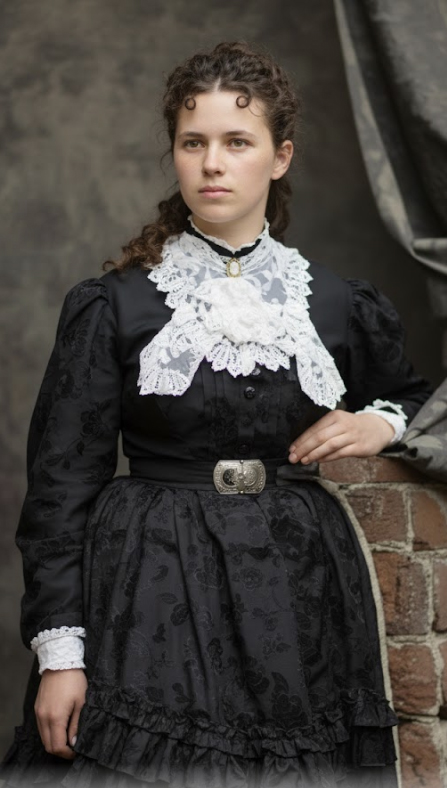
After the war, Hudson worked in Parksville and Kansas City. In 1872 he graduated from Spaldings Commercial College, in Kansas City, Mo. After his graduation, Hudson went to Kansas. My Dad said that while he was there, he did some work as a scout for the Army and later became interested in the stage. Shakespeare became one of his loves, until his death he, my mother told me, would quote The Bard at great lengths at the drop of a hat. In 1875 ‘he met and married, in Pomeroy, Kansas, Betsy Jane Gilbert. Betsy was member of the theatrical Gilbert family. They had two children, and on December 28, 1878, their third son Otto was born. He died ‘a few days later as did Betsy. They are buried in Old [Parkville] Cemetery. For the next two years Hudson took care of his two sons, William Emerson and Samuel Archer, while he worked as an accountant then as a building designer.

In 1880 he met Ida Antha Stone, the only daughter of Jacob and Ann Ayres Stone. We have an account of that branch of your line later on in this book. Hudson was 32 years old and Ida 19. They fell in love and when Hudson went to Ida’s father, Jacob, for permission to marry her, he found trouble waiting for him in the form of her mother, Elizabeth Ann. Oh yes! The fur did fly. Elizabeth Ann got her Irish up for sure. No widow man with two children was going to marry her daughter. Out you cad!! Hudson got out. A few weeks later the two eloped. Although both families lived in Springfield, your Grandmother Elizabeth Ann wouldn’t talk to either. But when Ida had her first child, Jessie Rue, the family was reunited.
Hudson was employed by your Great, Great,’ etc., Uncle R. C. Stone to work for the Stone Milling Company as a bookkeeper, then a millwright and lastly as a flour mill builder. Hudson found his life’s work at that point. The rest of his days would be spent designing and building mills. He built mills in Texas, Arkansas, Kansas, Missouri and China. The largest mill in the midwest was the one he built at Republic, Missouri, for the Stone Milling Co. One of his small mills was on Indian Creek at Stella, Missouri. worked in the mill one summer and felt very proud. when I looked at the huge hand-shaped timbers which went into the building of the mill and the system of gears reaching to the waterwheel in the creek. Grandad was a master builder.
Grandmother told me that “Mr. Staggs” (Grandmother never called him anything but “Mr. Staggs”) would be gone for a year or so and then, without any warning, the door would open and Mr. Staggs, looking tired and dirty, would come in. He, would drop his, carpetbag on the floor, take off his coat and unbuckle his money belt, throw the belt full of gold and silver coins on the table in front of her and say “How’s things with you, Ida?” Gram said that he might stay a week or a month then off he’d go to build another mill. That man had a lot of sand in his shoes to get rid of!
In 1889, Hudson had his brother Sam build a wonderful three-story house for him in Springfield. I’ve seen the house, and it was beautiful. Hudson then entered into a working agreement with his brother-in-law, R. C. Stone, taking time out to make trips around the country to build mills.
Load the wagons, we’re on our way.
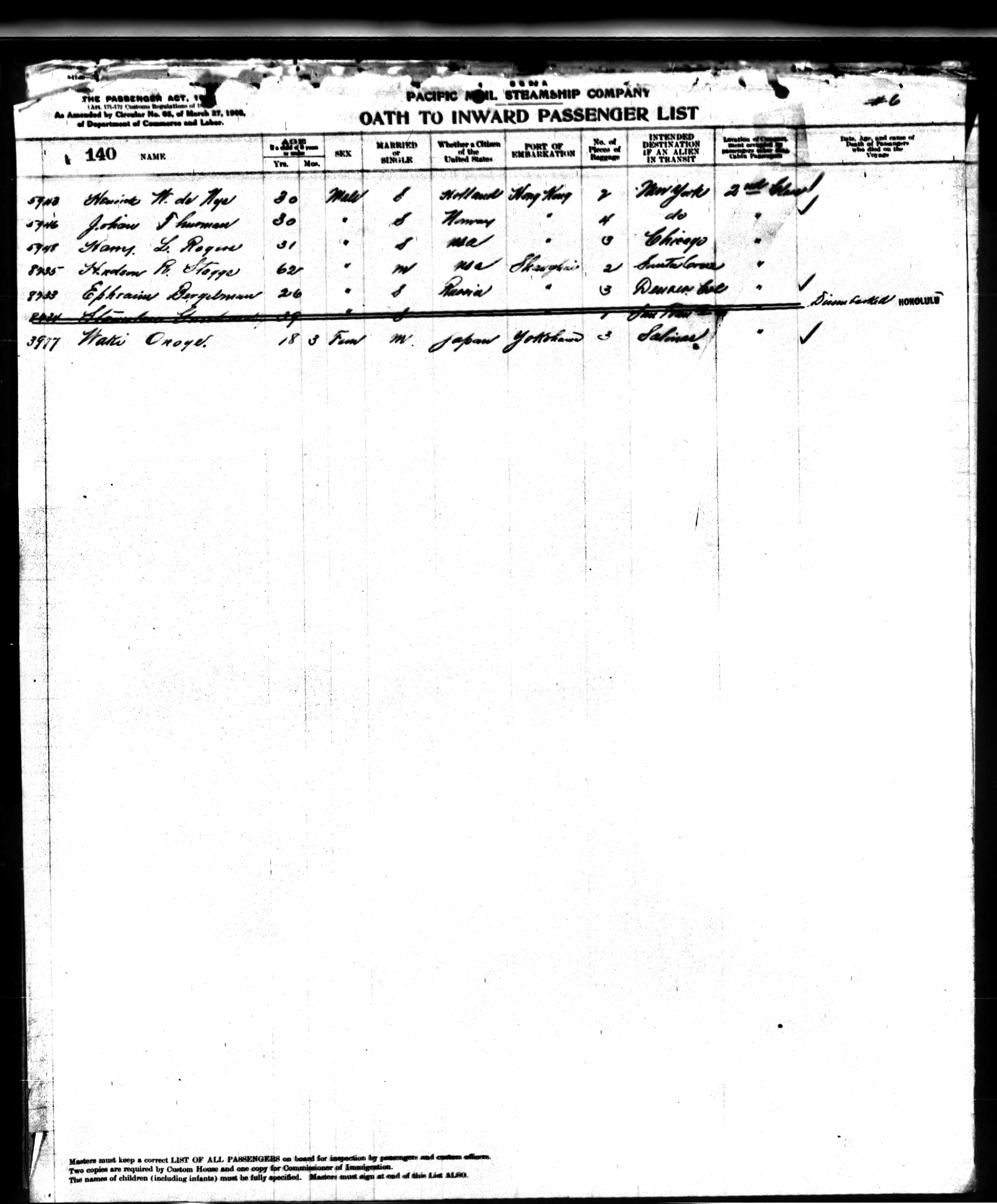
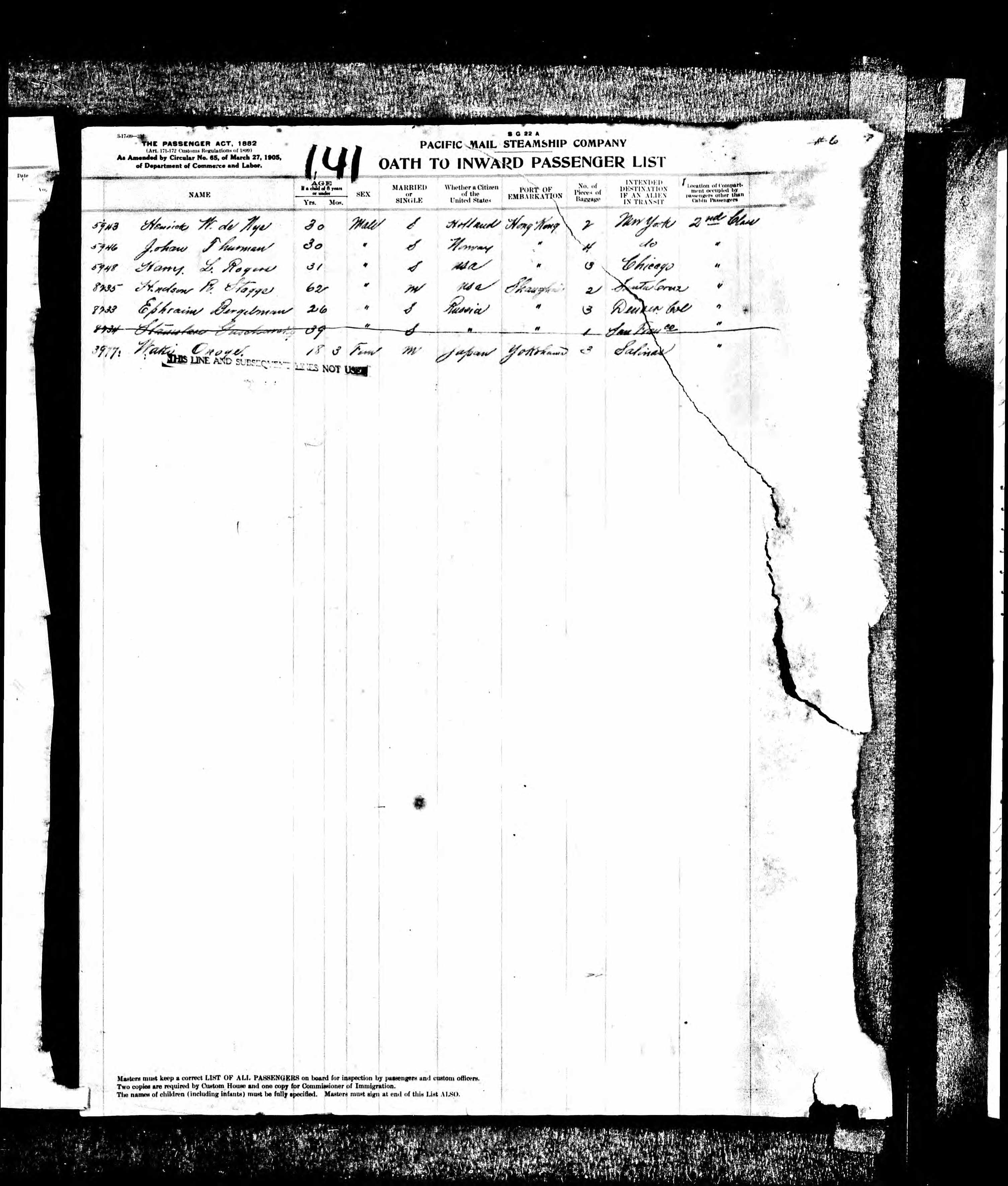
In 1903 the urge to move hit him (will we ever settle down) as it has hit the Staggs of every generation. So off to California he went. He bought an orchard near Santa Cruz and other properties in the Big Sur redwood area of Santa Cruz County. In 1905 the Barnard and Lense Company of Moline, Illinois, tracked him down and hired him to build several flour mills on the Yangtse River near Shanghai, China. Off Grandad went and the rest of the family went back to Springfield, Missouri.
While in China, my dad joined him to act as the manager of one of the mills. The other members of the family paid him one visit during his four-year stay. His two oldest daughters married into the Mace family. Sisters married brothers and my dad returned home to go to college and married Mom, Ella Blanch Wareham.
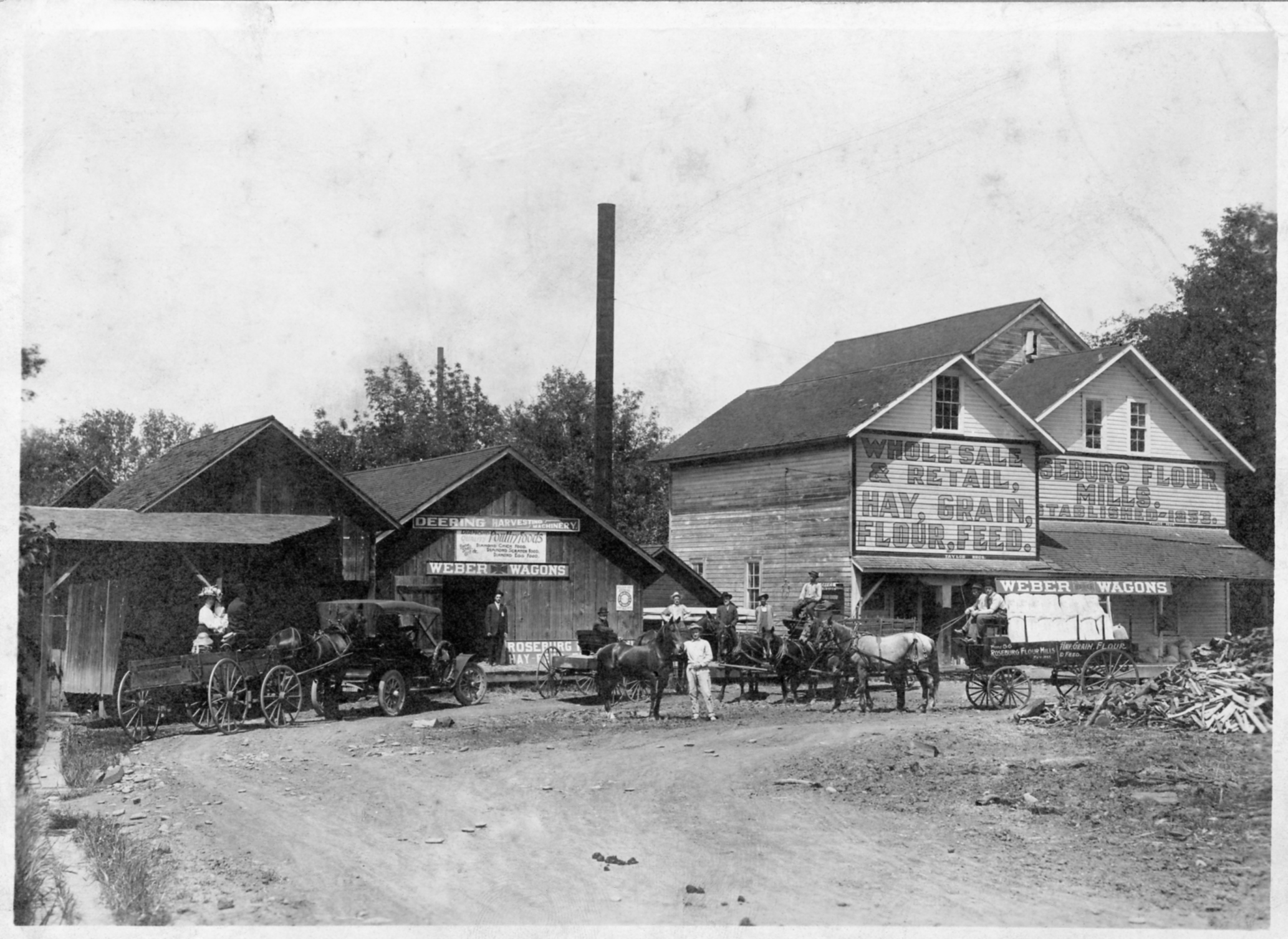
Hudson returned to the States, built his last mill in Boise, Idaho. Then entered into partnership with my dad and they bought a flour mill in Roseburg, Oregon, where I was born. No, not in the mill.
Grandad settled down for the first time in his life. I’m told that like all grandparents he doted over his grandchildren. Mother told me that he would take the boys down to the general store and let them pick out their daily candy ration, then back they would come to sit, solemnly, on the front porch until all the candy was eaten. He also took a joke well. One story is about salmon fishing.
Both families lived in the same big house. Grandad and Grandmother’s bed and sitting rooms were on the second floor. We slept on the first floor.
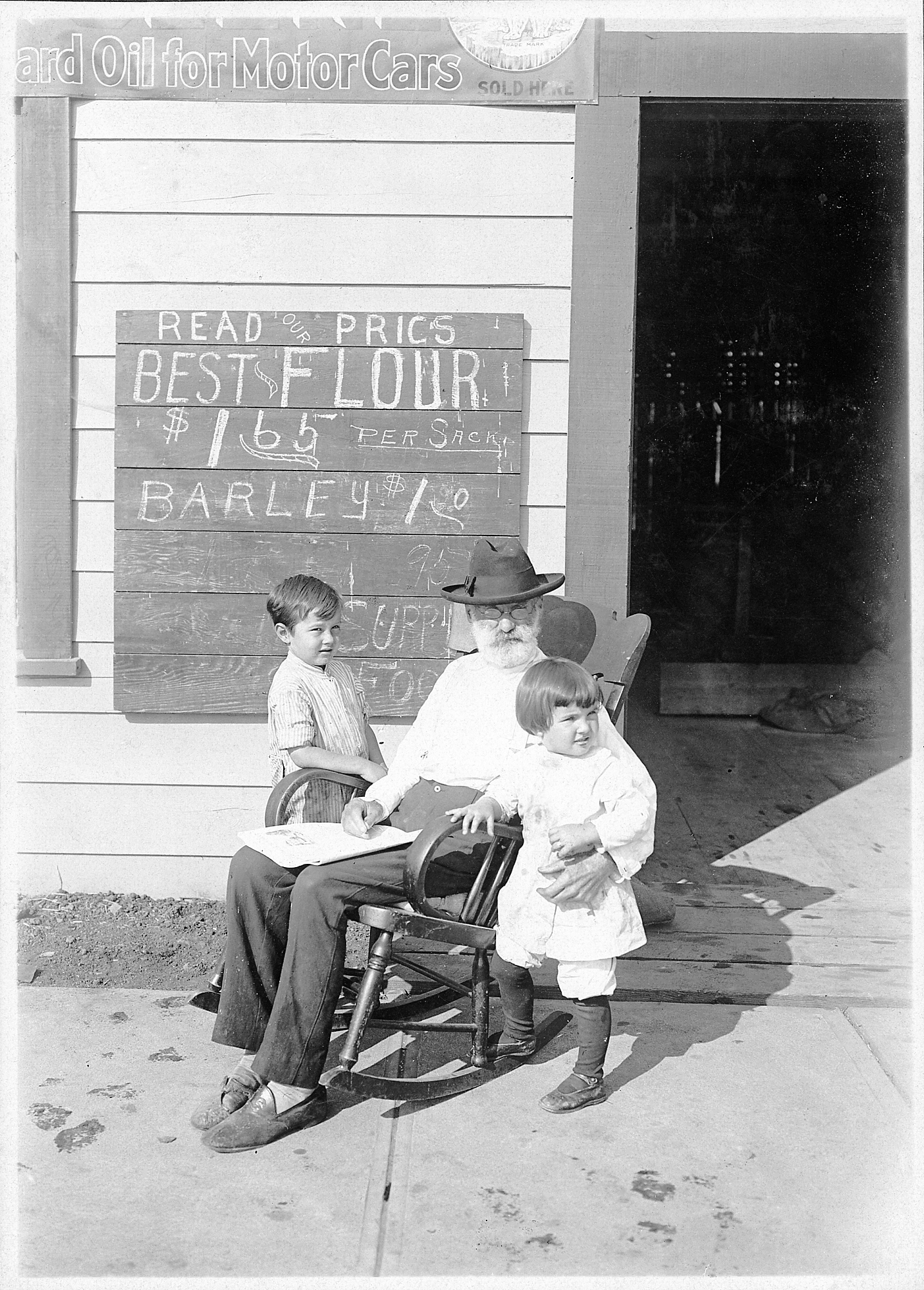
The mill, next to the house, was built on a creek so that waterpower could be used to operate it. Each fall, Hudson would put out several fish lines on which he caught salmon that had gotten into the millrace. These lines were attached to a bell which would ring when the line was pulled on by one of the big fish after it had taken the bait. One year my dad attached another line to, the bell which hung high about the bankside. Of course this was done after dark. That night after Grandad was in bed, Dad gave his end of the line, which ran to his bedroom window, a few hard tugs. The bell rang out loud and clear. Grandad jumped out of his bed, into his shoes and with nightgown flying rushed down the stairs to the back porch and lit the lantern then rushed across the back yard to his lines only to find them empty. Back across the yard (grumbling), blew out and rehung’ the lantern, (grumbling), in the house and up the stairs (grumbling), and back to bed.
Can you guess what happened about a half-hour later? Yep – loud and clear, Grandpop run, run, back again, grumble, grumble, up to bed, grumble, grumble.
Now who would think it? But yep, about a half hour later that fool bell started up again. Mother told me that by then she had her pillow over her head to stifle her laughter. One more time. – Gramps, out of bed, down the stairs (not so fast this time), lit the lantern – across the yard, then a long period of silence – back came Grandad – (no grumbling) – out the light and up to bed (no grumbling) – and into bed – Hudson had found the other line! Mother told me that she and Dad lay in bed shaking with laughter. Then the house rang with Grandmother’s shrieks of laughter too. Grandad had passed the story of the joke on to her.
Another? Well, one day Grandmother said to my mother, “Blanch, we’ve got to take that boy (my Dad) down a peg.” Ma thought that was a dandy idea, so they got their heads together.
About a month later a traveling carnival came to town. Ha, Ha! Now, the Staggs Mill did more than grind grain, it also sold hay, feed and seed. That day Dad came back to the mill after a short trip to town and found a note on the office door. It read something like this: Please deliver one ton of bailed hay to the corner of X Street and 15th Avenue. Unload it next to the horses. Please bill the attendant. It was hot for a fall day, and Dad sweat a lot loading that ton of hay on his freight wagon, but he got it loaded, mounted to the driver’s seat, snapped the lines on the teams’ rumps and away he went across to the other side of town. At X and 15th, he stopped the wagon and looked around for the horses. The only horsey thing on the corner was a merry-go-round! Dad had a lot of time to think as he drove back to the mill, and he got hotter. When he got to the mill there was that ton of hay to unload, and he got even hotter.
That night he closed the mill and went home. At the supper table, Ma asked him how things went at the mill that day. Dad said – “Just fine.” Ma and Grandma may have exchanged glances but that was all.
Days and days went by, and nothing was ever said about that hay. One evening while the family set silently and peacefully on the porch watching the light fade, Grandmother’s sweet voice softly asked, “Well, Richard, have you fed any wooden horses today?”
BANG! Down went Dad’s chair as he leapt to his feet – “I knew it!” he hollered, “I knew if I kept quiet, I’d find out! You two did it!” “You and Blanch”. He stomped off the porch. Ma and Grandma laughed until they cried. Later Dad came back from his walk laughing too.
Grandad Hudson died in his sleep February 19, 1916. He was buried in the City Cemetery, Roseburg, Oregon.
Obituary
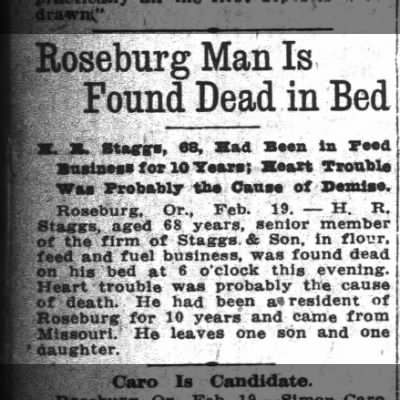
WAS PROMINENT MILL BUILDER
H.R. Staggs, senior member of the firm of Staggs & Sons of north Roseburg died at his home there shortly before 6 o’clock last Saturday evening, Feb. 19, 1916.
The cause of his death was pronounced to be extreme dilation of the heart. He had suffered two other attacks of this nature during the past few weeks, but apparently had been feeling better lately, and was about the premises as usual on Saturday. About 3 p.m. he retired to his room for a few hours rest, as he often did of late. After being called to supper at 6 o’clock for supper, and making no response, the examination showed that he had peacefully passed away, lying in bed as calmly as he had fallen asleep.
Mr. Staggs was a native of Missouri, and was about 65 years of age. As a boy he served as a bugler with the Missouri regiment during the Civil War. Later he took up the profession as a flouring mill engineer, which he followed for the major portion of his life. It is said that he erected more mills of that character, west of the Mississippi River, than any other living man. Later he went to Shanghai, China, on behalf of a large firm of flouring mill machinery builders; erecting seven large mills in that country. He spent more than four years in the Orient, and came to Roseburg with his family about two years ago. He held a leading rank in his profession, and also gained the highest esteem with those whom he came in contact. This condition prevail in the lands across the sea as well as in this country. Mr. Staggs awas survived by his wife, two sons and three daughters. They are: R.L. Staggs, and Miss Edith Staggs of North Roseburg; Mrs. E.B. Mace Springfield, Mo.; Mrs. C.C. Mace, Dequeen, AR. Wm. E. Staggs (son of a former marriage) Kansas City, Mo.
Legacy of Hudson Randolph Staggs
Parents
Father: Philip Beard Staggs (1810-1850)
Mother: Vianna C Randolph (1819-1895)
Married
1st: Elizabeth J. Gilbert (1856-1879).
2nd: Ida Antha Stone (1861-1930). Married August 5, 1880, in Waldron, Missouri.
Children
With wife Elizabeth J. Gilbert:
- William Emerson Staggs (1876-1916)
- Samuel Archer Staggs (1877-?)
- Hudson Otto Staggs (1878-1879)
With wife Ida Antha Stone:
- Jessie Rue Staggs (1881-1951)
- Mamie Toinetta Staggs (1884-1955)
- Richard Lesley Staggs Sr (1888-1965)
- Edith Antha Staggs (1892-1972)
Documents
- Birth Records
- There is no official birth certificate available–Missouri did not begin statewide birth registration until 1910. The census records (below) give his age at the time of census that would suggest that he was born in 1848.
- A Decree for Registration of Birth for child Edith Antha Staggs gives Hudson Randolph Staggs date of birth as October 22, 1848.
- Find a Grave gives a date of birth of October 23, 1848.
- Marriage records
- Missouri, U.S., Marriage Records, 1805-2002; Name: Mr Hudson R Staggs; Marriage Date: 5 Aug 1880; Marriage Place: Platte, Missouri, USA; Spouse: Ida Stone
- Death records
- Oregon, U.S., State Deaths, 1864-1971 > Baker-Gilliam > 1916 > Hudson Randolph Staggs
- Oregon, U.S., Death Index, 1898-2008; Name: Hudson Randolph Staggs; Death Date: 19 Feb 1916; Death Place: Douglas; Certificate: 29
- Find a Grave
- Military Records – Civil War
- Volunteer Enlistment April 7, 1865. Transcription. > Hudson R Staggs
- Muster-in and Descriptive Rolls of a Detachment of U. S. Vols. forwarded for the 14 Reg’t Missouri Cavalry > Hudson R Staggs
- Company Muster Roll September and October 1865, July and August 1865, and May and June 1865 > Trumpeter > Co. G, 14 Reg’t Missouri Cavalry > Henderson (Hudson) R Staggs
- U.S., Civil War Soldier Records and Profiles, 1861-1865 > Name: Hudson R Staggs; Enlistment Date: 1 Dec 1864; Enlistment Rank: Bugler; Muster Date: 1 Dec 1864; Muster Place: Missouri; Muster Company: G; Muster Regiment: 14th Cavalry; Muster Regiment Type: Cavalry; Muster Information: Enlisted; Side of War: Union; Title: Index to Compiled Military Service Records
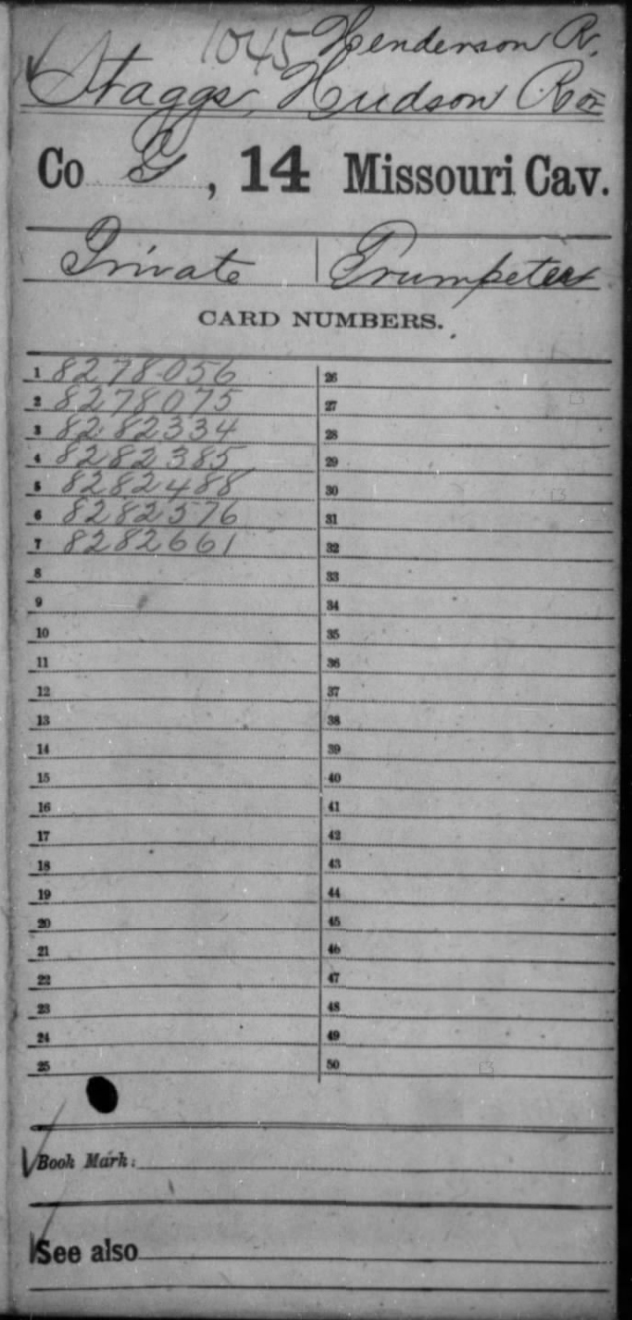
- US, Civil War Service Records (CMSR) – Union – Missouri, 1861-1865; The National Archives > Hudson R. Staggs
- US, Civil War Service Records (CMSR) – Union – Missouri, 1861-1865 > Military Unit: Fourteenth Cavalry, S-Y, Full Name: Staggs, Hudson R; Age: 18; Year: 1865; Estimated Birth Year: 1846-1847; Conflict Period: Civil War (Union); Branch: Union Army; Served For: United States of America; Roll Name: 0279
- US, Civil War Service Records (CMSR) – Union – Missouri, 1861-1865 > Hudson R Staggs
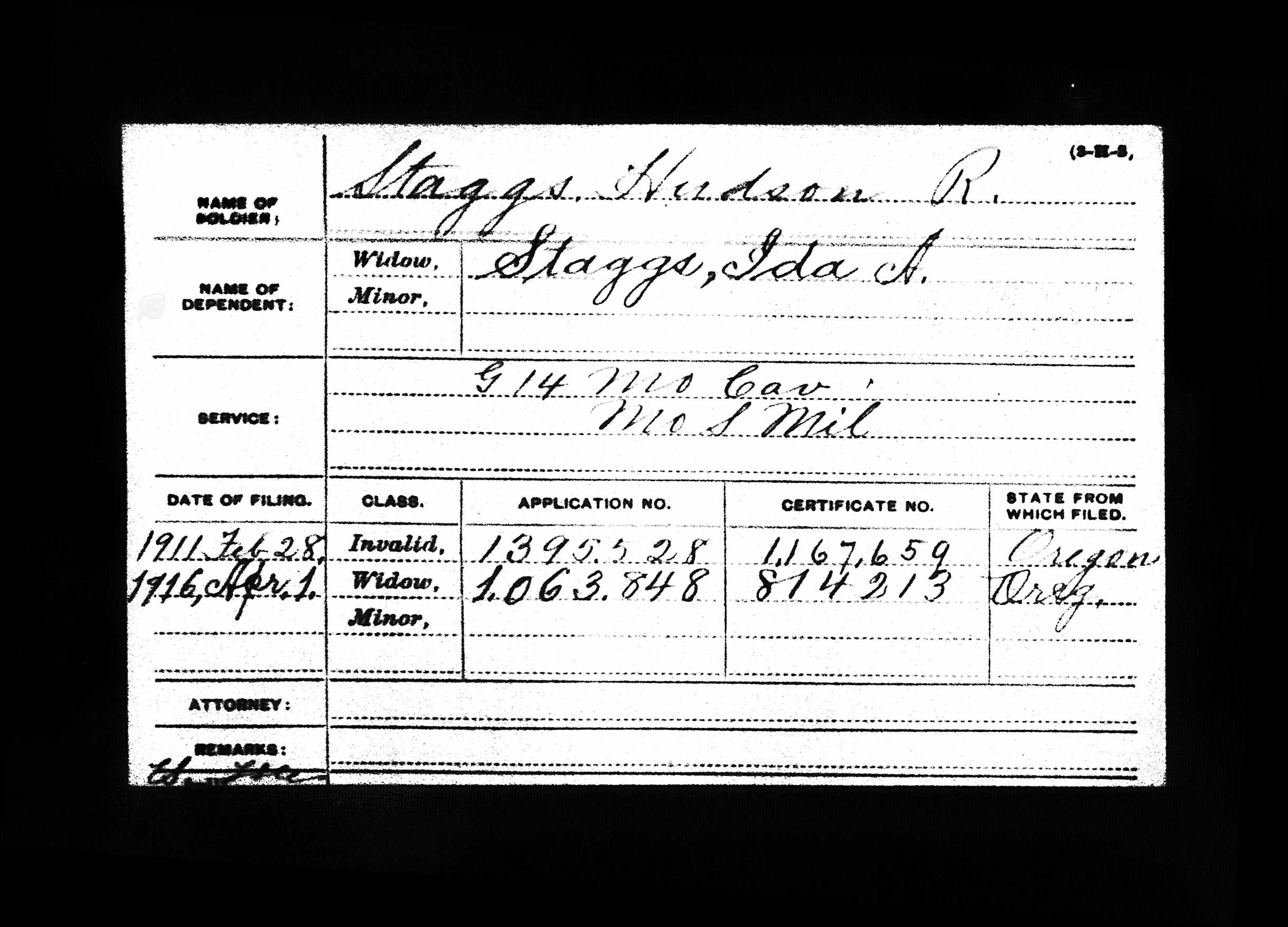
- U.S., Civil War Pension Index: General Index to Pension Files, 1861-1934 > Name:
Hudson R Staggs; Gender: Male; Unit: G 14 Mo Cav.; Mo S Mil; Filing Date: 28 Feb 1911; Filing Place: Oregon, USA; Relation to Head: Soldier; Spouse: Ida A Staggs
- Census Records
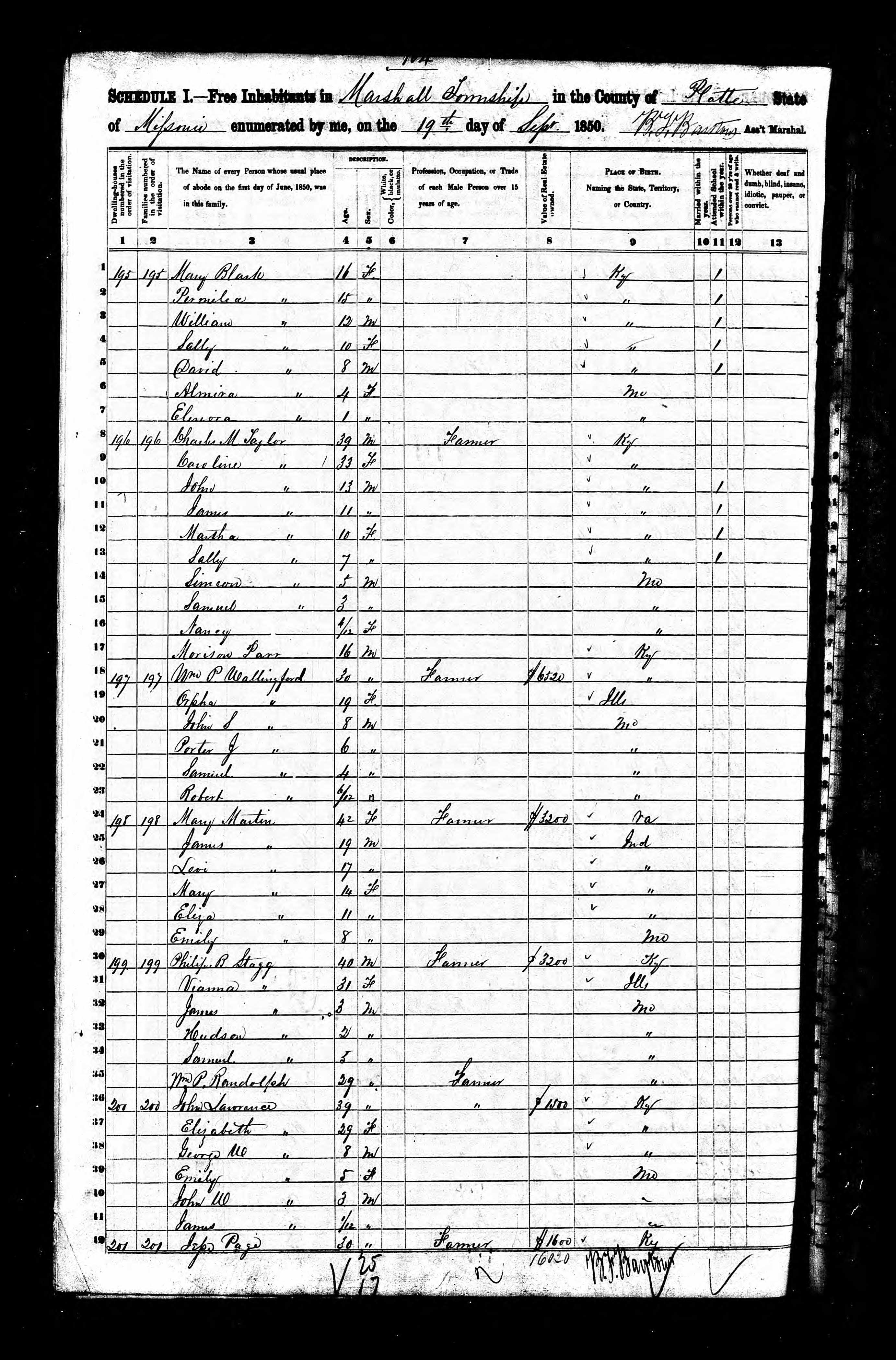
- 1850 United States Federal Census > Missouri >Platte > Marshall > Hudson Stagg
- 1870 United States Federal Census > Missouri > Platte > Pettis > Hutson R Staggs
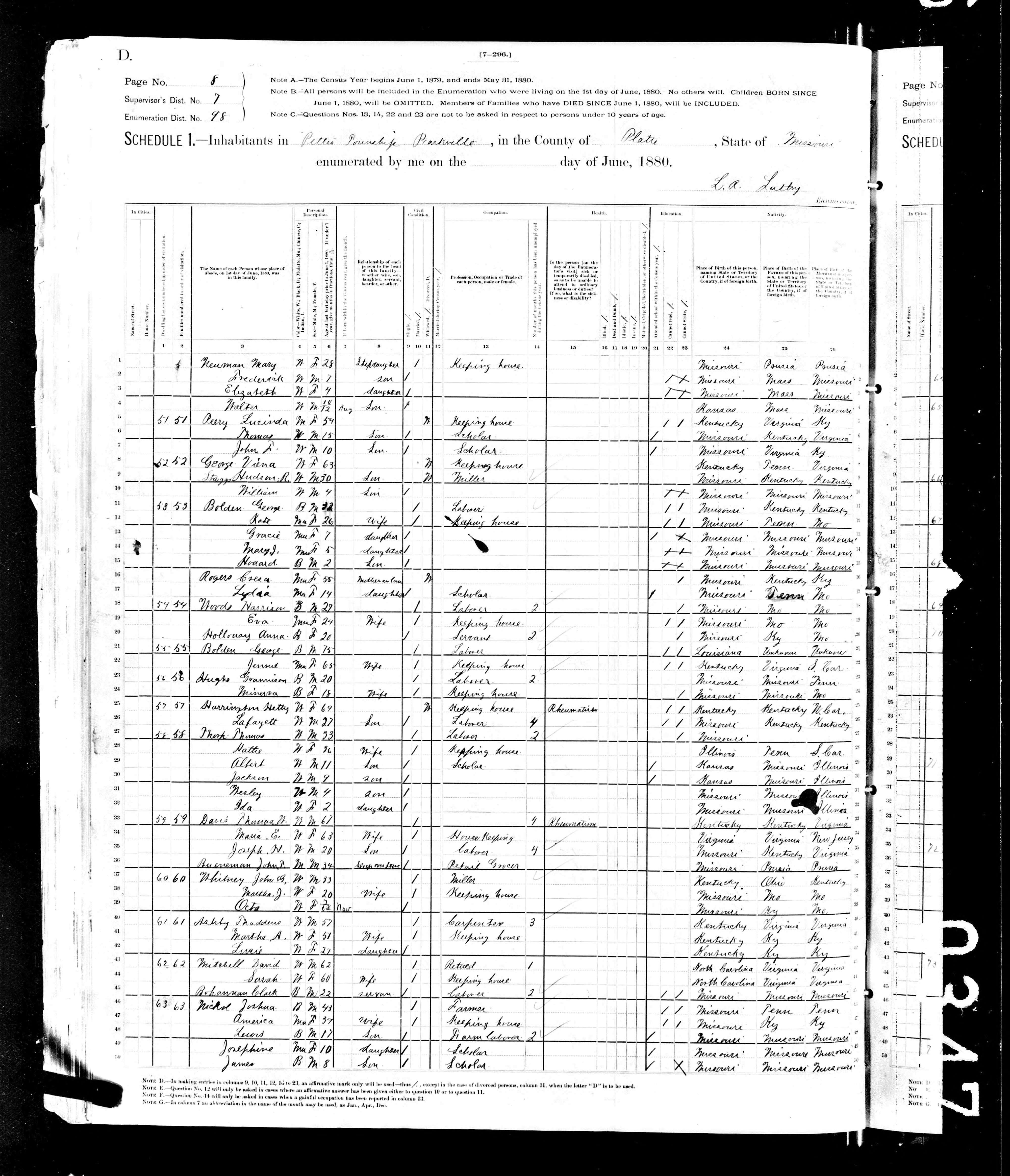
- 1880 United States Federal Census > Missouri > Platte > Parksville > 098 > Hudson R Staggs
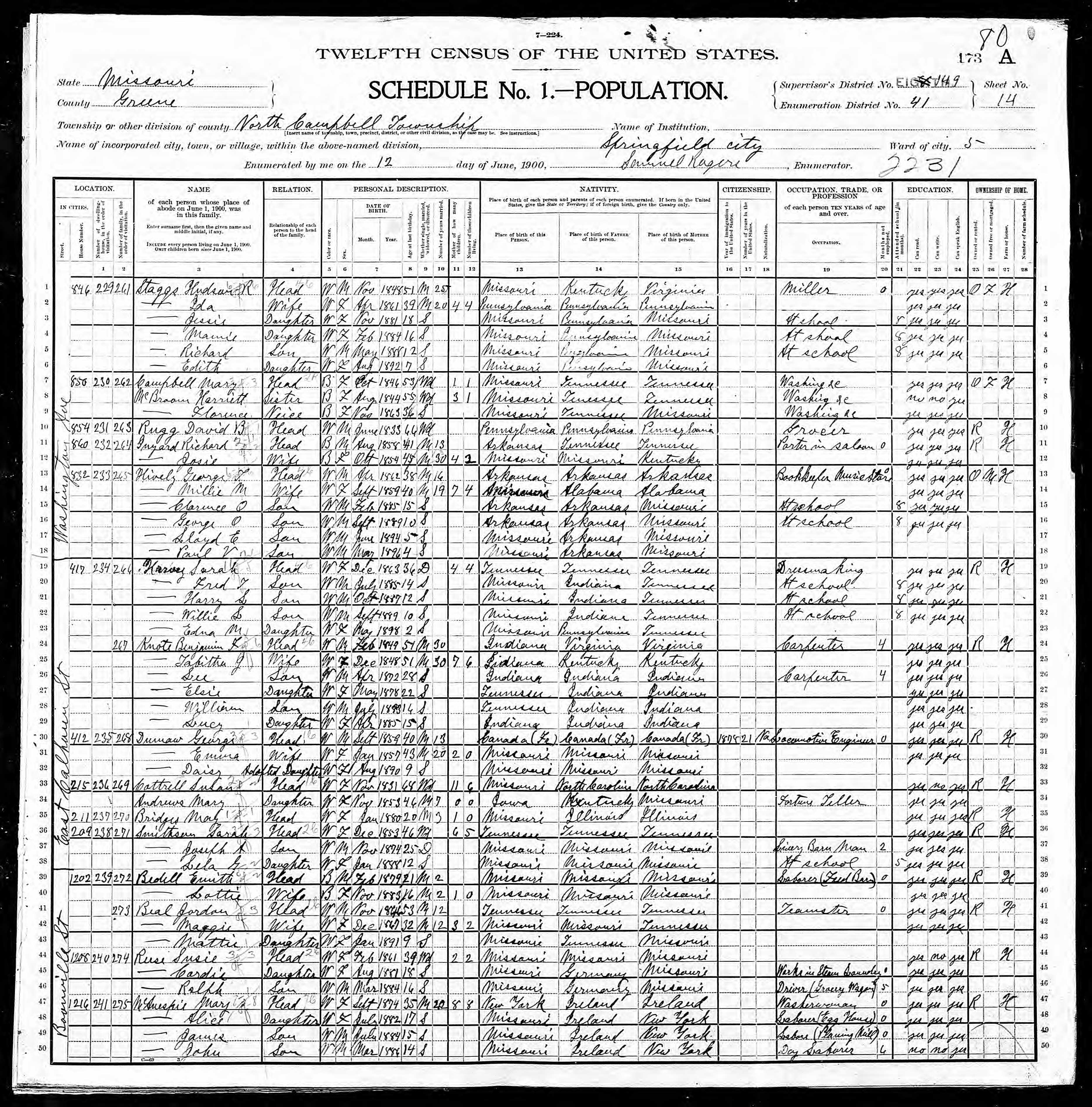
- 1900 United States Federal Census > Missouri > Greene > Springfield Ward 05 > District 0041 > Hudson R Staggs
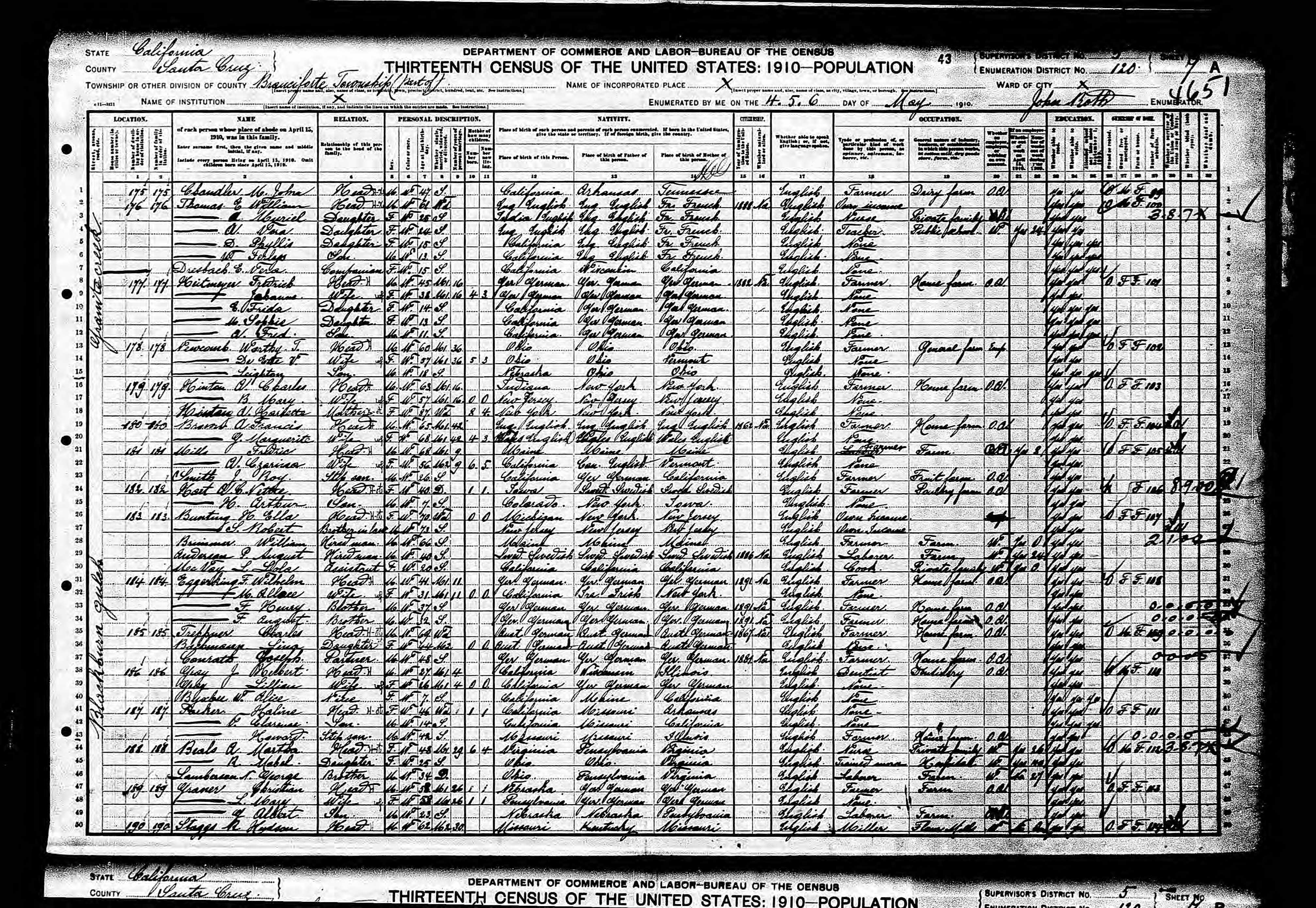
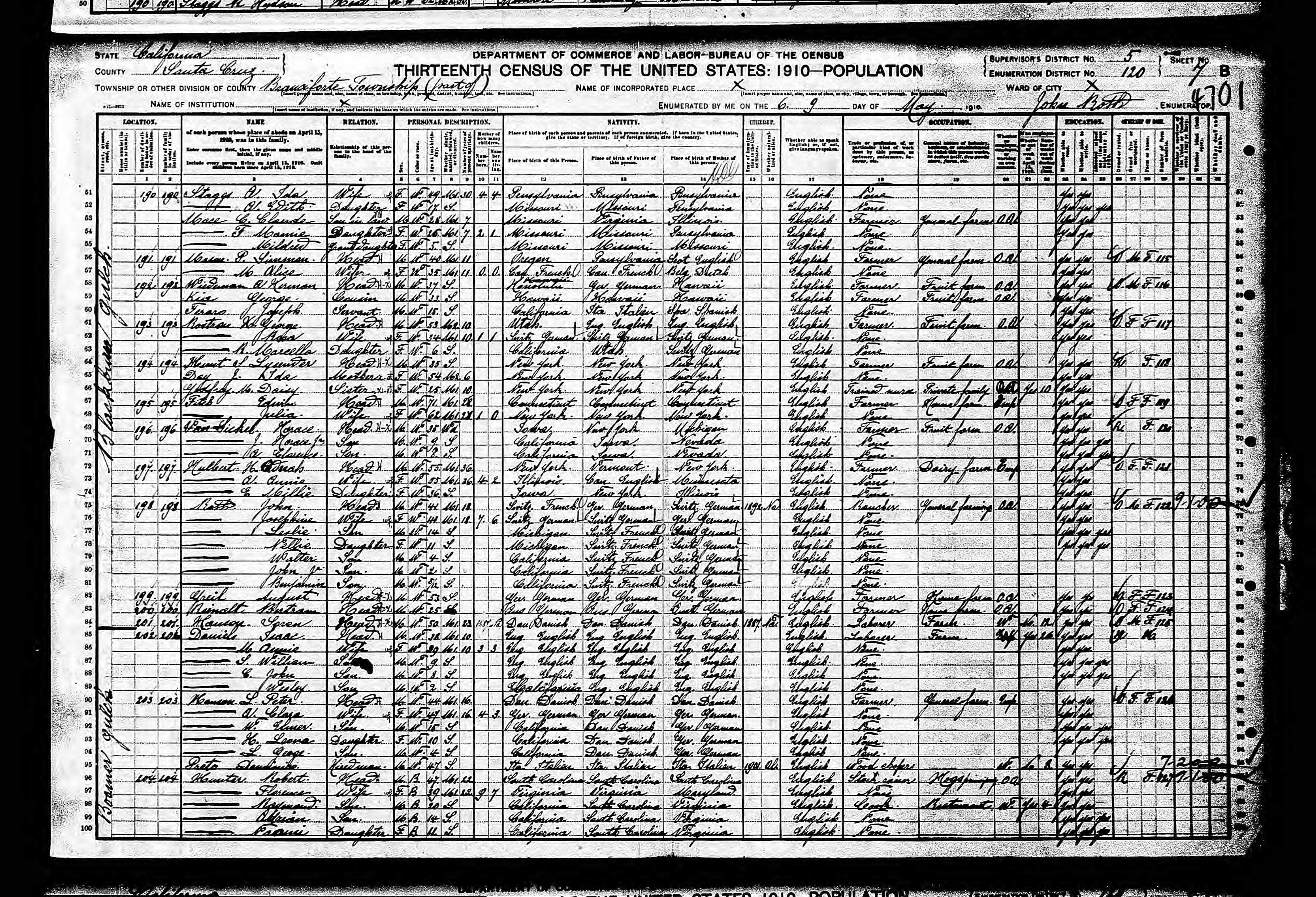
- 1910 United States Federal Census, page 1, page 2 > California > Santa Cruz > Branciforte Creek > District 0120 > Hudson R Staggs
- Other
Footnotes
- Note by Steven Barry Staggs: It is unlikely Vianna C Randolph was part Choctaw. She was my 2nd great-grandmother, and my DNA test results show no trace of Native American heritage.
- He was 16 years, 5 months, and 16 days old when he enlisted in the Union Missouri Volunteers, 14th Regiment, Missouri Cavalry on April 7, 1865. He mustered-in on April 11, 1865.
- Union Missouri Volunteers, 14th Regiment, Missouri Cavalry: Organized at St. Louis and Springfield, Mo., November 30, 1864, to May 13, 1865. Attached to District of St. Louis, Mo., to June 1865. District of the Plains, Dept. of Missouri, to November 1865. Duty at St. Louis, Mo., till June 1865. Scout from Waynesville to Coal Camp Creek May 23-26. Moved to Nebraska, and frontier duty on the Plains till November. Mustered out November 17, 1865. Lost during service 2 killed and 34 by disease. Total 36. (National Park Service, U.S. Department of the Interior website.)
Relation to Steven Barry Staggs: great-grandfather
Search the Staggs Family History site

 Staggs Family History