BIRTH: 1744, Massachusetts, USA
DEATH: 28 Aug 1817, Montgomery, Hampden, Massachusetts, UA
FATHER: Unknown1
MOTHER: Unknown
SPOUSE: Huldah Button (1752–1809)
David Crow was born in 1744 in Massachusetts. He married Huldah Button in 1771 in Chester, Massachusetts. They had three sons and several daughters during their marriage. He died on August 28, 1817, in Montgomery, Massachusetts, at the age of 73, and was buried there.

The Life of David Crow
A Life on the New England Frontier
David Crow was born in Massachusetts in the mid‑eighteenth century, a time when the western frontier of the colony was still being carved out of dense forest and rocky upland. His early years unfolded in a world of small farms, scattered settlements, and the constant push westward as families sought new land beyond the older coastal towns. By the time he reached adulthood, David had joined that movement, settling in the hill towns that would later become Chester and Montgomery — communities defined by hard work, close‑knit families, and the rhythms of rural life.
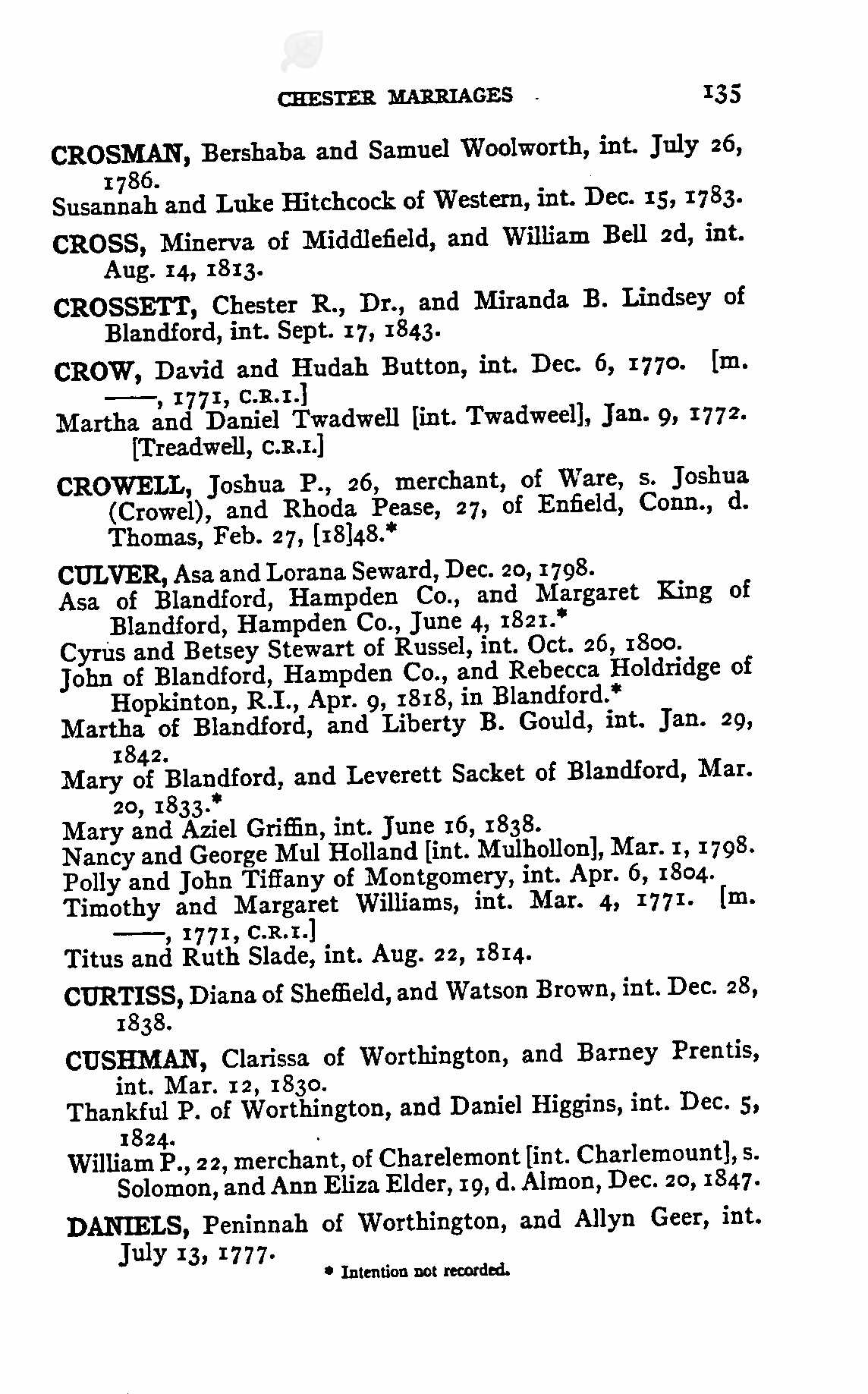
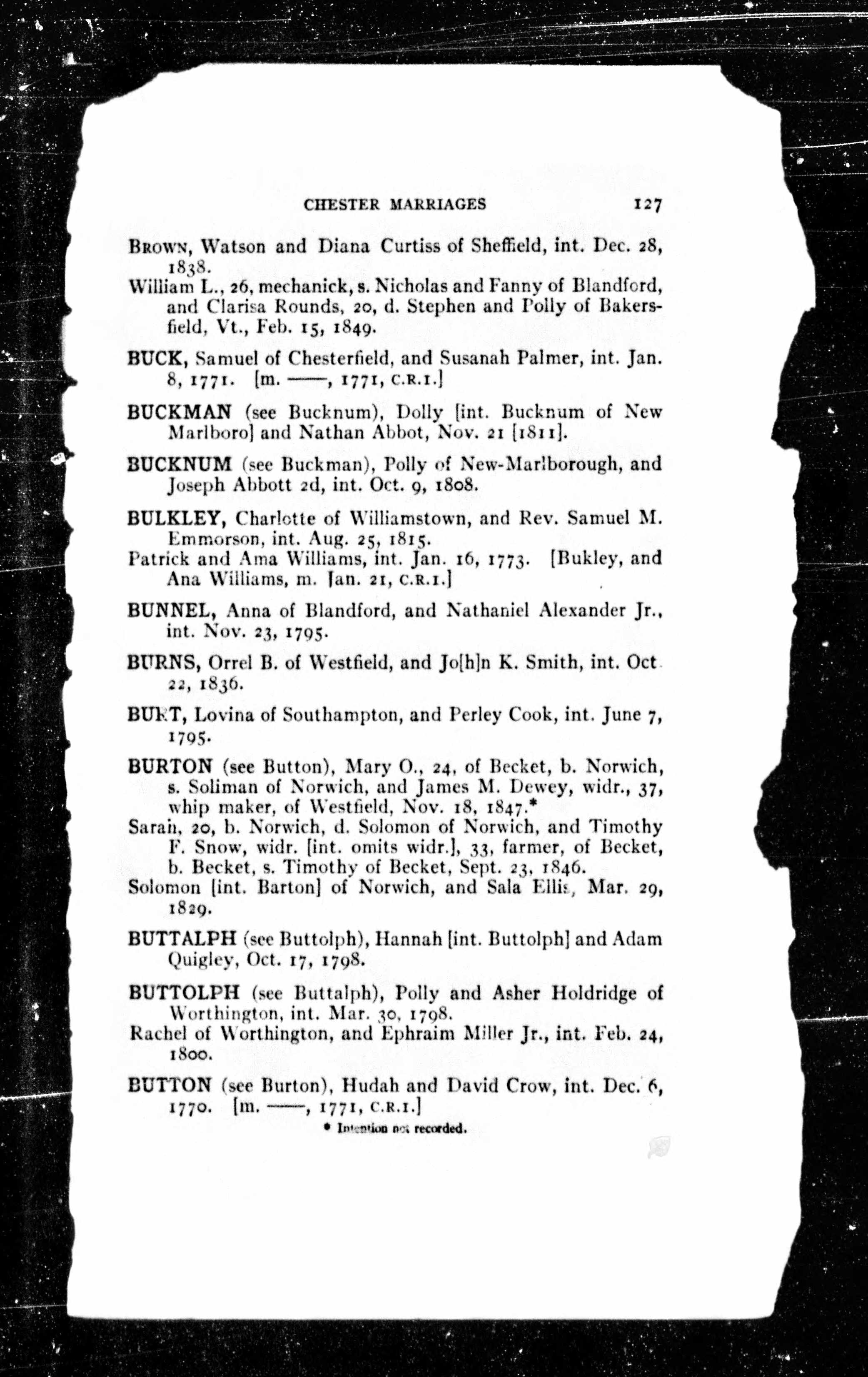
On 6 December 1770, David Crow filed intentions to marry Huldah Button, a young woman from a prominent local family whose roots ran deep in the Chester–Montgomery region. Their marriage, recorded in Church Record Volume 1, marked the beginning of a partnership that would anchor the Crow family in western Massachusetts for generations. Together they raised a household that grew steadily through the 1770s and 1780s — sons William, Horatio, and David Jr., along with several daughters whose names survive only indirectly through census counts and later family patterns.
Like nearly every able‑bodied man of his generation, David Crow answered the call to defend Massachusetts during the Revolutionary War. Listed as a Private in Massachusetts Soldiers and Sailors of the Revolutionary War (Vol. 4, p. 179), he served in the local militia system that formed the backbone of New England’s wartime defense. These companies guarded frontier towns, patrolled transportation routes, and provided manpower during the critical years when the new nation struggled for survival. Though his service was not in a famous regiment, it was the kind of steady, unglamorous duty that kept communities safe and allowed the Continental Army to function. His name appears in the same rosters as thousands of other Massachusetts farmers who shouldered muskets when needed and returned to their fields when the danger passed.
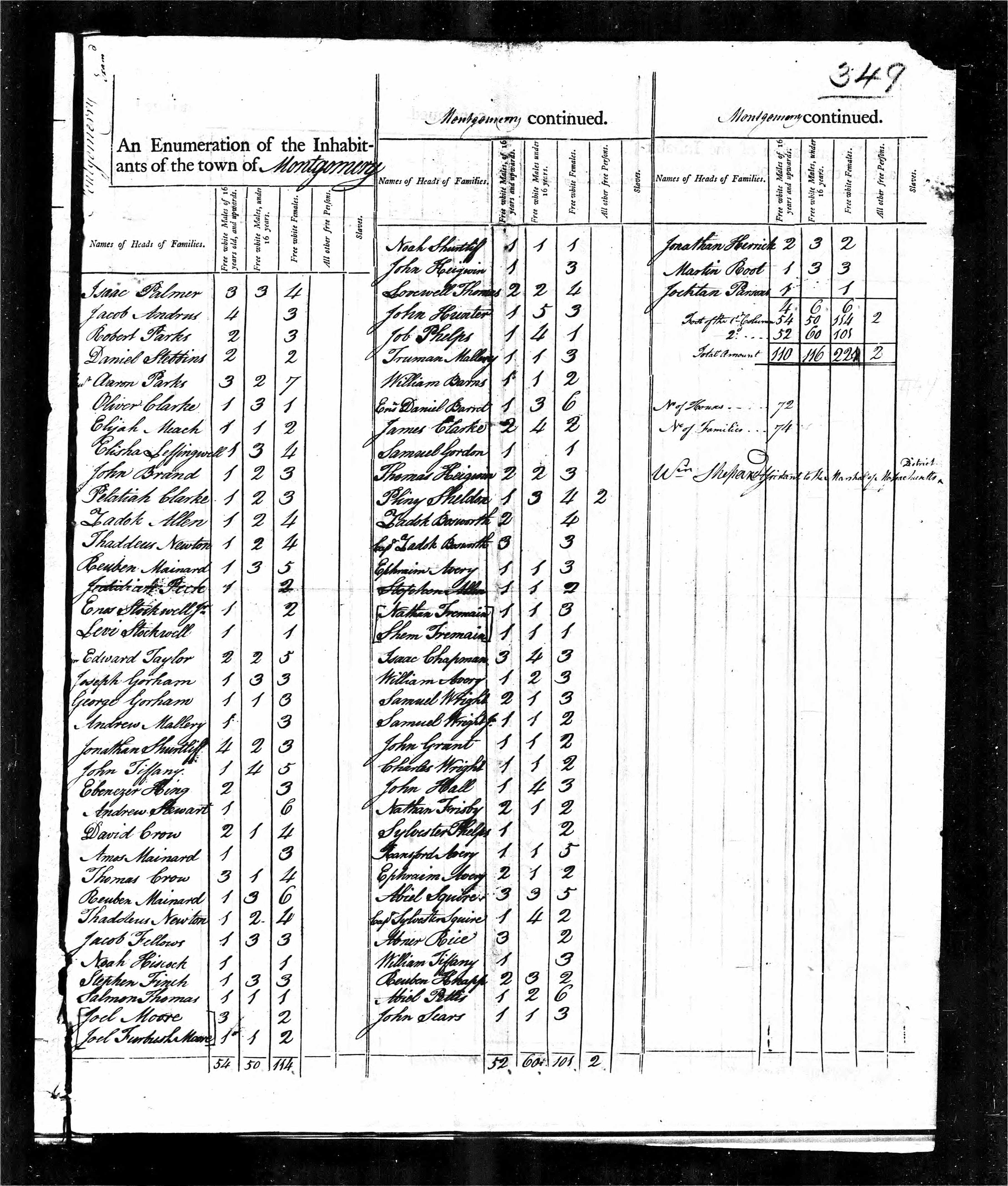
After the war, David continued to build his life in Montgomery, a town incorporated in 1780 and still very much a frontier settlement. He appears in the 1790 census as the head of a seven‑person household, a typical size for a family of his era. His children grew into adulthood as the region developed — new roads, new mills, and new towns rising around them. His eldest son, William Crow, married into the Avery family and would later carry the Crow name westward into New York and Indiana, beginning the long migration that eventually led to our own branch of the family.
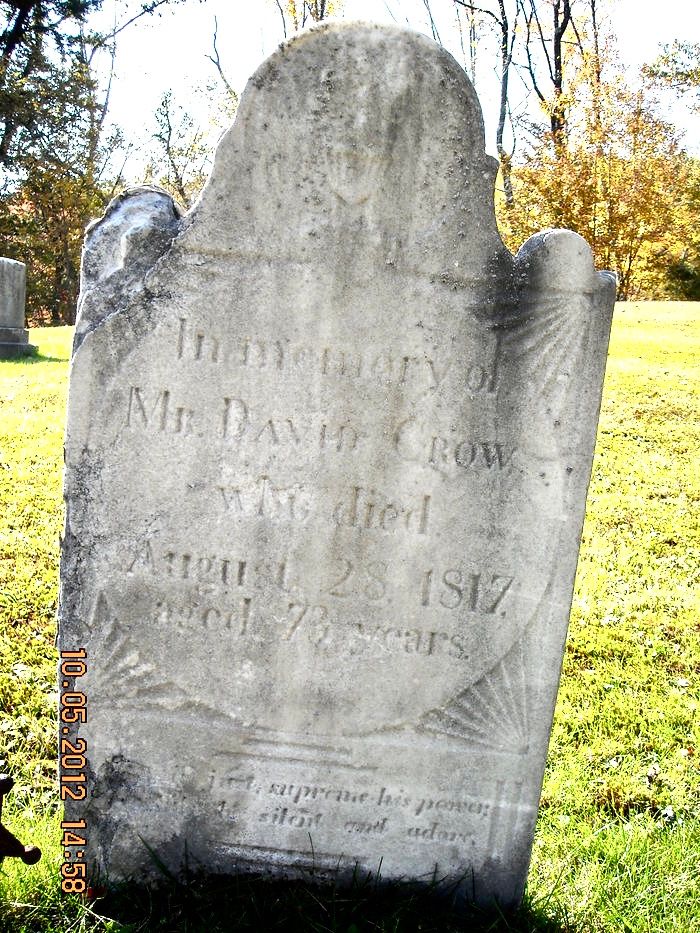
Huldah died in 1809, and David lived on another eight years, remaining in Montgomery until his death on 28 August 1817, at the age of seventy‑three. His gravestone still stands, weathered but legible, marking his resting place in the quiet hill country he helped settle. The following year, his estate was entered into probate in Hampden County (Case No. 3209), confirming his long residence in the region and closing the final chapter of his life.
Legacy of David Crow
David Crow’s legacy is woven into the early fabric of western Massachusetts. He was part of the generation that transformed the Chester–Montgomery wilderness into a network of farms, roads, and communities. His Revolutionary War service places him among the thousands of ordinary New Englanders whose quiet contributions sustained the fight for independence. Through his marriage to Huldah Button, he linked the Crow family to one of the foundational families of the region, and through his children — especially William Crow (1772–1845) — he became the patriarch of a line that would spread across New York, Pennsylvania, Indiana, and beyond. His life reflects the story of early America itself: migration, resilience, service, and the steady building of a family whose branches continue to grow more than two centuries later.
Parents
FATHER: Unknown1
MOTHER: Unknown
Married
Huldah Button (1752–1809)2 married in 1771 in Chester, Massachusetts
Children
- William Crow (1772–1845) married Abigail Avery (1782–1851)
- Horatio Crow (b. 1774-1776 – d. bef. 1800)
- David Crow Jr (b. 1775-1778 – d. 1860)
- Three daughters not named
Documents
- Marriage Records
- Massachusetts, U.S., Compiled Birth, Marriage, and Death Records, 1700-1850 > Chester > Name: David Crow; Intension Date: 6 Dec 1770; Married —-, 1771; Marriage Place: Chester, Hampden, Massachusetts, USA; Spouse: Hudah Button; Record from First Congregational Church of Chester
- Massachusetts, U.S., Town and Vital Records, 1620-1988 > Chester > Vital Record Transcripts > Name: David Crow; Record Type: Marriage; Marriage Date: 1771; Marriage Place: Chester, Massachusetts, USA; Spouse: Hudah Button; Record from First Congregational Church of Chester
- Massachusetts, U.S., Compiled Marriages, 1633-1850 > Name: David Crow; Gender: Male; Marriage Date: 6 Dec 1770; Place: Chester, Hampden, Massachusetts; Spouse: Hudah Button
- Death records
- Find a Grave > David Crow, Birth: 17 Mar 1744, Methuen, Essex County, Massachusetts, USA; Death: 28 Aug 1817 (aged 73), Montgomery, Hampden County, Massachusetts, USA
- Burial: Center Cemetery, Montgomery, Hampden County, Massachusetts, USA
- Census
- 1790 United States Federal Census > Massachusetts > Hampshire > Montgomery > Name: David Crow; Home in 1790 (City, County, State): Montgomery, Hampshire, Massachusetts; Free White Persons – Males – 16 and over: 2; Free White Persons – Males – Under 16: 1; Free White Persons – Females: 4; Number of Household Members: 7
Footnotes
- Although no surviving record names the parents of David Crow, several lines of circumstantial evidence point to John Crow (1707–1793) as a plausible father. John was one of the very few men bearing the Crow surname living in western Massachusetts during the period when David was born, and his age places him squarely in the correct generation to have fathered a child in 1738–1739, the birth window implied by David’s gravestone. The migration patterns of early settlers also support the connection: John Crow appears in the same hill‑town corridor—the region feeding settlers into Blandford, Chester, and eventually Montgomery—where David later established his home. Naming patterns strengthen the hypothesis as well, since both families used the same cluster of traditional New England names such as David, John, William, and Mary, suggesting continuity within a single Crow line. While no primary document links the two men directly, the combination of geography, chronology, rarity of the surname, and family naming traditions makes John Crow a credible, though unproven, candidate for David Crow’s father.
- Although some online trees list Lydia Parks as the wife of David Crow, this identification does not withstand genealogical scrutiny. The Lydia Parks marriage belongs to a different Crow family located in Middlesex County, far from the Crow–Button–Avery cluster in Montgomery and Hampshire County, Massachusetts. No record places a Lydia Parks in Montgomery, nor does she appear in any Crow, Button, or Avery family documents from that region. In contrast, Montgomery town records, local tax lists, and the naming patterns of David’s children all point consistently to Huldah Button (1752–1809) as his wife. The presence of a son named Horatio—a Button family name repeated in the next generation—further confirms the Button connection. Thus, the Parks marriage belongs to a separate Massachusetts Crow line and has no documentary relationship to the David Crow who fathered William Crow (1772–1845).
Relation of David Crow to Steven Barry Staggs: 5th great-grandfather
Page last updated June 25, 2026
Search the Staggs Family History site

 Staggs Family History